National Guild for Community Arts Education Announces Series of Town Halls in October

New York, NY – The National Guild for Community Arts Education is thrilled to announce a series of Town Hall events across three key cities in the upcoming month. These meetings will serve as platforms to spark excitement for the upcoming conference, connect with local arts organizations and leaders, discuss Guild membership and support, and foster deeper city connections. 

The agenda will include remarks by Guild leadership and local partners, presentation on the state of community arts education and the Guild’s current work, structured networking, discussion and brainstorming and a preview of what to expect from the upcoming 2024 Conference for Community Arts Education.

Washington, DC Town Hall
Location: DCCAH
Date/Time: October 25, 2023, 5-7pm
In collaboration with DC Collaborative

Richmond, VA Town Hall
Location: Lily Black
Date/Time: October 12, 2023, 5-7pm

Baltimore, MD Town Hall
Location: The Cube
Date/Time: Oct 19, 2023, 5-7pm

Members of the media are invited to attend, cover, and engage with community members, leaders, and educators during these events. For further details, registration, or media inquiries, please contact: Quanice G. Floyd at quanicefloyd@nationalguild.org

About the National Guild for Community Arts Education

The National Guild for Community Arts Education is a national network of arts education organizations and practitioners. With a mission to ensure all people have opportunities to maximize their creative potential, the National Guild promotes excellence in and access to lifelong learning opportunities in the arts.

Announcing 2024 Conference for Community Arts Education Theme

New York, NY – The National Guild for Community Arts Education is thrilled to announce the theme for its highly anticipated 2024 Conference: "Seeding Fractals: Cultivating Connections, Multiplying Impact." This dynamic event will take place in the vibrant city of Washington, D.C., from April 9 to April 12, 2024.

Seeding Fractals: Cultivating Connections, Multiplying Impact

Inspired by adrienne marie brown’s Emergent Strategy, the theme for the 2024 Conference captures the essence of community arts education: the power of interconnectedness and the exponential potential for positive change. In nature, fractals represent intricate patterns that repeat themselves on various scales, from the smallest leaf to the grandest tree. Similarly, the community arts education sector thrives on fostering connections and relationships that lead to multiplied impact.

Learn more about our theme and our 2024 Conference in our new press release!

Organizational Retreat in Chicago

June 28, 2023

From May 31 to June 2, Guild staff and board visited Chicago for a three-day organizational retreat (we also held a Community Space gathering with Chicago community arts education practitioners—read about that here).
 

Seven people standing in a half-circle, most of which are on the stage of a school auditorium.         A library with bookshelves lining the walls, and the floor covered in large string instruments in cases.

On our first day, we were thrilled to be hosted by Merit School of Music—a longtime Guild member organization, where Guild trustee and former board chair Duffie Adelson was President for many years (and is now a Life Trustee). We were fortunate to get a tour of the building from Duffie. 

One highlight of the tour was the library which, in addition to books, includes musical instruments and even formal concert attire available for students to borrow.
 

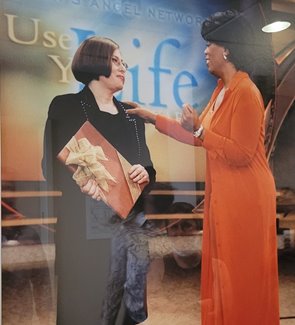
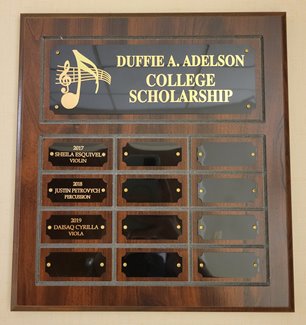
Duffie Adelson on stage at the Oprah Winfrey show, with Oprah facing her with her hand on her shoulder.        A plaque that reads "Duffie A. Adelson College Scholarship" with an image of music notes, and the names of scholarship recipients listed at the bottom.

It was beautiful to see evidence of Duffie’s legacy as we walked around the building, including a photo of Duffie on the Oprah Winfrey show talking about Merit’s work, and a plaque listing recipients of a scholarship in Duffie’s name.
 

During that first day we made significant strides in our strategic planning process with consultants Heather Heslup and Allegra Brown. They got the creative juices flowing by starting us off with a collective artmaking activity.


A large piece of brown paper taped on the wall, with vibrant abstract shapes in colorful paint.

Our masterpiece!

During this in-person session, we focused on Strategic Directions, which included setting SMART goals, creating measurable outcomes to support those goals, and deciding which goals will be prioritized in the timeline of the next few years. This set us up for the final step of the process, which is action planning.


Strategic planning consultants Heather and Allegra seated at the front of the room, while Guild staff and board members sit and stand around tables in a "U" formation.

The Guild has undergone deep transformation over the past couple of decades, and the Portal has provided us with an even deeper opportunity to reimagine this 85+ year old organization and our position in the community arts education field. We have now reached a stage in this process where the shape of the Guild’s future is more concrete, and there’s a lot of energy and excitement around what has emerged! Thank you to all who have provided input during this process, and we can’t wait to share the new strategic plan with you this fall.
 

A circular tapestry with a mandala print on it. Blue and bright yellow post-it notes with words on them have been arranged around the edge of the circle.

On our second day, we met at the National Museum of Mexican Art. We had a restorative circle facilitated by Jainelle Robinson, where we talked about some of the challenges and conflicts that have come up as part of this transformative organizational process. We began with an activity where we each wrote down the values that are most important to us in this work, and then added them to a circle in the middle of the room so that we could collectively ground in our shared values.

The retreat concluded with staff presentations, board committee reports, and board discussions about how they can support all of the work that’s happening now and moving forward.

Thank you to Duffie Adelson for being our local trustee and point person, and Merit School of Music and the National Museum of Mexican Art for hosting us!

Recap: Chicago Community Space

June 28, 2023

Two people having a conversation in the seats of a high school auditorium.

Community Space attendees connecting with each other. Photo by Zoha Hussnain
 

On June 1, we gathered with Chicago area community arts educators at The Chicago High School for the Arts (ChiArts) to hear their perspectives on the present and future of community arts education, and what kinds of support they need. 

As we did at our previous Community Space gatherings in Boston, the San Francisco Bay Area, and Memphis, we asked attendees a series of questions about what community arts education looks like in Chicago, what challenges they are facing in their work, what kinds of programs and resources would be most beneficial to them as individuals and to their organizations, and what inspires them. 

We were delighted to be joined by Miss Illinois International, Mandy Marsh, whose platform is arts education for children!

Guild Executive Director Quanice G. Floyd standing with Miss Illinois International Mandy Marsh, who is wearing a crown and sash. Both are smiling.

Guild Executive Director Quanice G. Floyd and Miss Illinois International Mandy Marsh. Photo by Zoha Hussnain
 

Participants shared that the Chicago community arts education field is vibrant and collaborative, but access to creative learning opportunities is not yet equitable across different areas of the city. People expressed a need for more resources (funding, meeting space, technology, etc.) for community arts education; increased compensation, decision making power, and professional development opportunities for teaching artists; more programming for adults; and more funding and opportunities to teach indigenous art forms and values. Some shared that it can be challenging to provide a supportive creative environment when many of their program participants are dealing with economic challenges and violence in their communities.


Three large flipchart papers covered with writing in marker and on post-it notes.    Two masked people standing in front of the stage in a high school auditorium. The person on the left is pointing to Post-It notes placed on a large sheet of paper, which is being held by the person on the right.

Flipchart papers full of attendees’ answers to the prompts (left), and Aurora reading the answers aloud while Guild Deputy Director Ashley Hare holds a flipchart paper up (right). Photo by Zoha Hussnain
 

When asked what would be helpful and supportive in their work, participants mentioned that the Guild could set a bar for equity in the field; support national accountability around teaching artist pay (the Teaching Artist Guild’s Pay Rate Calculator was mentioned as a valuable resource); and provide networking, and professional development, and leadership opportunities.

Four people sitting in auditorium seats. One of the people on the left is holding a microphone and speaking. The two people on the right have their bodies turned towards the speaker, and one is wearing a mask.

Community Space attendees participating in discussion. Photo by Zoha Hussnain
 

Visions of the future of community arts education included removing colonial practices from community settings; making cities more liveable for artists; lifelong learning and intergenerational engagement; embracing new technology and innovation; and more places for the arts everywhere!

Nineteen people standing in a circle, surrounded by seats in a high school auditorium.

Our closing circle. Photo by Zoha Hussnain
 

Thank you to everyone who attended, The Chicago High School for the Arts for being such gracious hosts, and Zoha Hussnain for capturing photos of the event!

Message from Quanice: June 2023

June 28, 2023

Dear Guild Family,

I often reflect on how the transformative power of love manifests in community arts education. Love unites and liberates us, infusing our work with purpose and meaning. It is through our love for the arts that we find the courage to explore uncharted territories, experiment with innovative techniques, and express ourselves authentically. Love emanates as a profound commitment to fostering inclusive spaces where individuals of all backgrounds feel welcomed, celebrated, and empowered to explore their creative potential. 

Such spaces allow us to cultivate intergenerational connections, honor the wisdom and creative spirit of all community members, and nurture empathy and understanding. Artistry becomes a catalyst for personal growth and community transformation. By fostering creativity and providing tools and support, community arts educators contribute to the flourishing of our shared human experience.

With these reflections deeply etched in my heart, I am inspired to harness the transformative power of love within the realm of community arts education. Let us collectively ensure equitable access to arts education by creating inclusive spaces where artistry and community intertwine, where all individuals can thrive and find solace, and where the magic of artistic expression becomes a beacon of hope and social change.


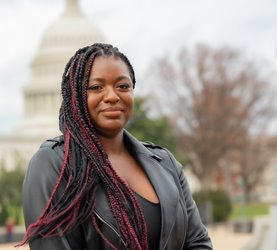
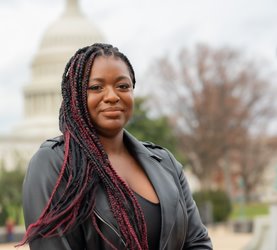
Portrait photo of Quanice G. Floyd. She is wearing a black jacket and has red and black braided hair. The Capitol building can be seen behind her.

Quanice G. Floyd
Executive Director

Welcome to the team, Rhiannon R. Martin!

June 13, 2023

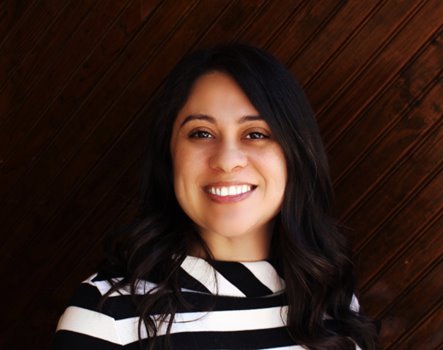
A person with light brown skin and long black hair, standing in front of a deep-tinted wooden wall. They're pictured smiling and wearing a black and white pattered shirt.

We're excited to welcome Rhiannon R. Martin to the Guild staff as Governance and Admin Manager! This part-time position will provide administrative management, serve as a liaison between the Executive Director and Board of Directors, and work closely with the Executive Director and board to support the organization's mission and goals.

Rhiannon (she/her) is a passionate community leader, arts administrator, event producer, documentary storyteller, change advocate and activist, based in Dallas, Texas. As a proud Hispanic woman, Rhiannon strives to honor, uplift, and empower historically underrepresented communities in her service to the community through mindful engagement and equitable collaboration, and works to see more representation and inclusion in the arts and beyond.

You can read Rhiannon's full bio on our staff page.

Message from Quanice: May 2023

May 23, 2023

Dear Guild family,

As the Guild’s programming makes its much-anticipated return this fall, our collective efforts to embrace liberation align seamlessly with the mission and the future work of the National Guild. This pivotal moment calls for us to honor the past, challenge oppressive systems, and envision a reimagined future that empowers all voices. Together, we embark on a transformative journey of liberation, shaping the landscape of community arts education. Let us delve into the collective journey that lies ahead.

Reflect, Appreciate, and Decolonize:

As we gather at future events, we reflect upon the rich tapestry of community arts education, appreciating the beautiful artistries and cultures that enrich our field. In this shared celebration, we acknowledge the need to challenge and decolonize oppressive systems ingrained within community arts education. By dismantling barriers and fostering inclusivity, we create a space where all voices can flourish.

Embrace Innovation and Intersectionality:

At the heart of the Guild lies the spirit of innovation and intersectionality. As members of the community arts education field, we have the power to embrace new perspectives, celebrate art form fusion, and ignite critical conversations. By embracing intersectionality, we foster empowerment, empathy, and liberation through artistic expression.

Cultivate Collaborative and Liberatory Spaces:

The Guild will serve as a catalyst for cultivating collaborative and liberatory spaces. Together, we dismantle hierarchies, foster inclusivity, and amplify historically marginalized voices within the community arts education community. By engaging in dialogue and nurturing partnerships, we create transformative artistic experiences that support and uplift individuals and communities.

Advocate for Liberatory Policies and Resources:

The Guild’s future programming will provide the platform to advocate for liberatory policies and secure essential resources for community arts education. Our collective voice carries immense power. Let us unite in advocating for inclusive curricula, equitable funding, and policies that address systemic injustices. Through collective action, we effect systemic change and ensure community arts education becomes a driving force for liberation and empowerment.
 

Together, we are embarking on a collective journey of liberation, honoring, acknowledging and reckoning with the past, and envisioning a reimagined future of community arts education. Let us unite, challenge oppressive systems, and co-create a future where community arts education empowers all individuals and communities.


Portrait photo of Quanice G. Floyd. She is wearing a black jacket and has red and black braided hair. The Capitol building can be seen behind her.

Quanice G. Floyd
Executive Director

Staff Post: Getting “Unstuck”

May 23, 2023

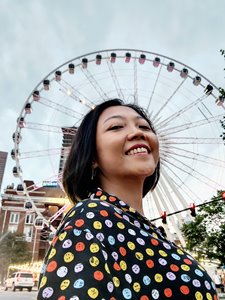
Smiling, olive-complexioned Southeast Asian woman with dark-brown hair in a short bob cut, wearing a black shirt dotted with colorful smiley faces, in front of a large ferris wheel that creates an illusion of a halo around her head.

by Rangsey Keo, our Director of Finance & Administration

(If you prefer to listen, click here for a voice note version of this post from Rangsey.)

“Stuck”

I’ve never thought of myself as much of a creative—not in the sense that I don’t dabble in any form of arts whatsoever, but rather that I’ve never considered myself the type to make something new. I copy, replicate, and adapt. I take in what I see, hear, and learn and adapt it to my own understanding and way of expression. That is how I do art, and that is also how I work. I can look at something and, using the multitude of knowledge I’ve gathered and experiences I’ve had and heard from, think of many ways to improve it. But, I’ve never been asked or given the opportunity to completely recreate something in its entirety. Because, in all my previous work, improvement was more than enough, if any was asked of me at all. So, when the Guild entered the Portal and we began reimagining and recreating our functional work teams (or as we began calling them, “pods”), I got stuck.

My field of work is Operations. How does one reimagine something that is so focused on the “doing” part of an organization, that the idea of dreaming up something new feels vague? Operations, to me, has always seemed a list of tasks to complete and quantifiable goals to reach based upon the dreaming of others (governance, programs, etc). Particularly in an organization like the Guild—one with a long history of the classic hierarchical structure typical of midsize to large organizations in our non-profit sector (which we are now working on reimagining). More often, I’ve been asked to figure out how to achieve goals already decided upon by upper management and/or a board of directors, or wait upon the program team to give me a list of things they need for a program to run. I was stuck inside the operational box, and could not envision what to put on this new blank canvas I was given. I felt lost.

Do Something Else (preferably physical activities)

After weeks of frustration at my current state of “stuck and lost”— partially due to my stubbornness to ask for help from fellow staff who were also busy with their respective pod reimaginings and research— I finally threw my hands up and decided to do what has always worked for me in the past when in this situation, which was to forget all about it.

No, this didn’t mean I had given up. Rather, I decided to put it away for the time being and step away from this dilemma entirely because I realized continuing to run around in circles within the problem was leading me nowhere. So, I stepped out. I stopped thinking about it. I went and did something else. I still completed my mundane, operational tasks, I organized our physical office (we were in the process of moving), I read articles that had nothing to do with operations or my work, I did gardening, aerial yoga, archery, anything that did not involve thinking about what an operations pod/team/department could or would look like.

It helped—particularly the physical activities, because when my thinking gets stuck, I let it rest and have it focus on the movement of my body. It’s pretty amazing how intake of knowledge, sensations, and experiences from doing various activities can spark an idea towards a solution.

Going Back to the Roots: What is the purpose of “Operations”?

A thought came to me.

I didn’t have to start from scratch. Particularly with a team function that involved a lot of “doing”. So, I simply typed “nonprofit operations” into my browser’s search bar and skimmed through the varying definitions.  From that, I surmised the commonality among them to create my own one-liner definition for operations: the primary role of the operations team is to ensure the Guild teams are equipped and empowered to do what they do.

As such, I decided to internally call this work pod “Cog Movers”.

Then, after further research on various job descriptions of a variety of operational roles, I compiled a list of duties and responsibilities that fit this definition. I did the equivalent of looking through other artwork for inspiration to set a theme, and collecting scraps of various things that fit said theme.

Sorting Things into Categories

Now that I had my jumbled list of responsibilities—my scraps—it was time to sort them. Much like trying to sort something by color, I grouped anything that seemed related into various categories. And after merging, unmerging, and re-merging different groups of tasks and activities, I came up with five major functions: Human Resources, Budgeting (finance), Systems (administration), Vendors (contract management), and Trail-making (documentation and contingency planning). With Human Resources being its own pod at the Guild, I’m left with four major functions for the Operations pod.

Chart showing the four major functions of "Cog Movers" pod. The center has a yellow bubble titled "Cog Movers" with four arrows pointing to four smaller, peach-colored bubbles titled with the function name (clockwise from top left: "Budgeting", "Trail-Making", "Systems", and "Vendors"). Under each peach-colored bubble is text describing each function. The chart is dotted with various small cliparts.

Breaking it down into chunks to work on is much more manageable than what I was trying to do in the beginning—creating the full picture in one shot. This is the age-old advice of “divide and conquer” applied. The rest is simply a matter of listing further detailed tasks and responsibilities for each main function, and connecting the dots.

It’s still a work in progress. As I’m fulfilling these responsibilities and collaborating with the other pods, I constantly discover more tasks that can be added, merged, modified. When we reach a point where we expand this pod to have more humans, these functions may look rather different to fit our needs.

Tips from the Toolbox

Using definitions found on Google doesn’t work for everyone. I know there are folks who better process in and create from other forms rather than words: visual, auditory, and movement, to name a few. In fact, if you scroll back up to the top of my blog post, you’ll find that I started out by doing things, using movement and motion to spark inspiration. I used words to create a base to work with, and then eventually produced something that was a combination of words and images.

Some already know what type(s) of form they prefer at each stage, but others may be just discovering it. For those still in the stage of discovery, I recommend some of the below.
 

Visuals:

  • Look at images, videos, or go sightseeing for inspiration.

  • Draw or paint what comes to mind when thinking about something—use images online even.

Movements:

  • Do something fun, something you like. Dance. Jog. See what crops up.

  • Use motion to describe something. Record it to refer back to (and permanently delete evidence of moments of embarrassment afterwards if you like, although I personally don’t think anyone needs to feel embarrassed).

Auditory:

  • Listen to music, a podcast, or sound clips. Head to a beach and listen to the sound of waves crashing against the shore or hike a trail and listen to the rustle of the leaves in the wind.

  • Add sound clips to your creation, or name a sound to help describe something.

  • Record yourself talking about your creation.

This toolbox of tips is by no means exhaustive. To some (or perhaps many in our field of arts and arts education), the things I’ve listed may be nothing new or surprising, so I am curious of the various ways other folks use to make a breakthrough when stumped about what to do or where to begin with their projects or work. The Guild will be holding a Portal Cafe on this topic on June 15th where I will share and discuss further about resetting and finding inspiration to get “unstuck”. I invite you to join us for this session to discuss creative ways of problem-solving or even to explore any questions on what “operations” is and means, particularly in a non-profit.
Recap: Data Considerations Portal Cafe

May 11, 2023

On April 13th, we gathered virtually for a Portal Cafe facilitated by Claire, our Member Services and Data Systems Manager. This was the second in our series of Portal Cafes—virtual discussions about the learnings and practices we’re developing in the Portal, in which attendees are encouraged to bring their own thoughts, questions, and learnings to share (our first Cafe was about liberatory hiring practices—you can read that recap here). 

This conversation was based on Claire’s blog post about considerations when collecting demographics data from program participants. As part of our effort to become better aligned with our Racial Equity Guiding Principles and Policies, Guild staff identified a need to better understand who we’re currently reaching (and not reaching). We made our first attempt at sharing an optional demographics survey with program participants, vendors we worked with, and other collaborators. Claire and our Deputy Director of Equity and Human Development, Ashley Hare, intentionally built in opportunities for respondents to give feedback about the survey itself—so that we could learn what we’re getting wrong, what we’re getting right, and what we’re missing in this process. 

Claire shared reflections on the very valuable feedback that we got from respondents, and how it has shifted the way we think about asking our community for information about themselves. When the conversation opened up to attendees, many were grappling with similar questions about data collection at their own organizations. 

Some key takeaways from the conversation:

Ground yourself in the needs of the community.

  • Questions to ask yourself: 

    • What impact(s) might the collection of this data have on our community? 

    • How can/will this effort give something valuable back to the community?

Come to a shared understanding with your colleagues across the organization (who may have varying data needs). 

  • Questions to ask yourself: 

    • Why are we collecting this data? What are we trying to achieve? 

    • What boundaries will we set in place?

Be clear and up-front with participants about your reasons for collecting data, intentions for how the information will be used, and their options for participation.

  • If you explain why you’re gathering the info, people are more likely to be on board with it. And if they’re not on board, they can tell you why—which might also be helpful info!

  • If people can opt out from sharing their information, make sure this is abundantly clear.

Allow people to self-identify.

  • Questions to ask yourself:

    • If we assume people’s identities based on how they look, whose presence might we be erasing from our data?

    • Does our data about people’s identities need to be accurate? If not, is it data we really need? Back to one of the earlier questions—what are we trying to achieve?

Tips and tricks 

  • All aspects of our work can be creative and fun—even data collection!

    • At a community event, try putting a survey on a tablet near the line for something popular—like food, a photo booth, or a sticker making machine. People are more likely to want to interact while they wait and pass the time.

  • Connect on an individual level

    • One participant shared that only 15% of students had typically filled out a google form survey each quarter, so they decided to print out the form, memorize a script, and visit each classroom to talk through the survey in person with students. This may also be a supportive option for people with accessibility needs that make filling out online forms difficult.

  • Utilize publicly available data

    • If you’re not able to gather data directly from your community or don’t want to ask them personal questions, you can instead use proxy data about the communities you serve, based on publicly available sources such as City Council district websites.

The bottom line: 

Get really clear about what you’re looking for, and why. Then ask yourself—what are some fun, creative ways we can get to that information, while respecting participants’ agency and needs? 


Thank you to everyone who came and shared your thoughts and questions! We loved learning alongside you about how to care for communities in the ways we handle data, while gathering the information needed to assess our impact and tell the story of our work. As our time in the Portal continues to teach us, many of us in the field are often dealing with the same questions and challenges.


Keep an eye out for an announcement of the next staff blog post and Portal Cafe topic very soon!

Message from Quanice: April 2023

April 26, 2022

Happy Spring Guild Family,

I hope this transmission finds you well. I am excited to share with you some of the progress that the National Guild for Community Arts Education has made during our Portal. The Portal has been aimed at reimagining and reinvigorating our organization's purpose and direction for the future. We recognize that the world is changing rapidly, and it is our duty to stay current and relevant while continuing to serve our members and communities.

Of course, this has been as new for us as it is for you. With that, we have learned and achieved a lot during this process. We've been engaging with a wide range of stakeholders, including Guild members, teaching artists, arts education leaders, funders, policymakers, and other community leaders. We’ve listened to their feedback and suggestions, and we are proud to say that we are making significant progress in our efforts to be more responsive, inclusive, and impactful. The board and staff are committed to supporting the community and have been working hard to ensure that our programs and services are inclusive and accessible to all.

One of the key insights emerging from the Portal is that we need to change not what we do, but HOW we do things. In other words, we need to transform our organizational culture, structures, and processes to better serve our members and communities. This requires a deep commitment to equity, as well as a willingness to experiment, learn, and adapt.

Our mission as a service organization is to serve people through our work, keeping community at the core of our values. Our members and communities are facing unprecedented challenges, such as systemic racism, economic inequality, environmental degradation, and political polarization. We believe that the arts can play a powerful role in addressing these challenges by fostering creativity, empathy, critical thinking, and civic engagement.

To support our future work and stand up for our communities and peers in community arts education, we are calling on folks in the field to take action. Here are some ways you can get involved:

  1. Support the Guild: The National Guild for Community Arts Education is a nonprofit organization that relies on the support of our community. By making a donation or becoming a member (or renewing your membership), you can help us continue to provide programs and services that promote equity and justice in the arts.

  2. Advocate for arts education: We believe that the arts are essential to a thriving society. By advocating for the arts in your community, you can help ensure that everyone has access to the transformative power of the arts.

  3. Stand up for justice: We cannot achieve equity in the arts without addressing the systemic and historical injustices that have marginalized so many. By standing up for justice in your community, you can help create a more just and equitable society.

The Guild is committed to serving our community through our work in community arts education. As we move forward, we are looking to change how we do things—not what we do—by more deeply prioritizing advocacy, leadership, equity, and justice in all that we do. We are calling on our community to join us in this important work. Together, we can create a more just and equitable society through the transformative power of the arts and community arts education. 

P.S. Please stay tuned—we have amazing programs forthcoming!


Portrait photo of Quanice G. Floyd. She is wearing a black jacket and has red and black braided hair. The Capitol building can be seen behind her.

Quanice G. Floyd
Executive Director