Staff Post: Data Considerations

by Claire, our Member Services and Data Systems Manager

March 16, 2023

If you prefer to listen, click here for an audio version of this post.

In 2023 our lives are more online than they've ever been. That means our data, too, is gathered in so many different ways and by countless organizations. I know it frequently gives me pause when I'm asked for information that seems personal or that does not seem aligned or necessary to what I'm trying to accomplish online, so it is perhaps fitting—or ironic—that it’s become an increasing part of my job at the Guild to support our data strategy practices. In the Portal of Transformation, part of my work has been helping to drill deeper into why the Guild uses data: how we collect it respectfully, how we analyze it, and how we use it to inform our work.

To do that, we had to first start with our “why”. There are a ton of reasons for an organization like the Guild to collect information about the folks with whom we engage. One of the reasons for the Portal was to take a step back and to ensure that the Guild’s actions were in alignment with our Racial Equity Guiding Principles and Policies. But to know if we are centering the experiences of those who have been historically marginalized and truly serving all, we need to actually know who that “all” entails, and to make sure that the folks we are reaching represent the full breadth of the community arts education field. For that reason, one specific thing we wanted to make space to review and work on were revisions to the Guild’s demographic survey. For context, at the end of 2021 we began collecting optional demographic data that we hoped could tell us more about who we are serving, while also pointing out gaps in our service. That data asks about race, ethnicity, gender, sexuality, ability, and wealth (or lack thereof), to name a few topics. Knowing who we are engaging, and perhaps more importantly, who we aren’t, helps to keep us accountable to our communities—reminding us that, while being truly inclusive is difficult, it is essential and necessary to our identity and our mission. 

While that survey felt like an important first step, we didn’t expect to get it exactly right on the first try. Since the initial launch of the survey, under the guidance of Ashley Hare, our Deputy Director of Human Development, we have intentionally asked for feedback from survey respondents to help us know what we are getting wrong, what we are getting right, and what we are missing. The feedback we received has been tremendously valuable. Among what we’ve learned is that, as hard as we tried to be inclusive, we occasionally fell short. Some participants questioned our need to gather data about wealth (a controversial heading title in its own right!), feeling like questions around finances were too intrusive. Others asked us why we ask about wealth and property ownership, but not about debt, which was a great question for us to reflect on.

Another challenge we’ve tried to address from the beginning is the balance between affirming people’s identities, while still being able to analyze data quickly and efficiently. Data practices can already feel academic and detached from humanity. When we narrow the scope of choices a survey respondent has in order to more easily report on them it can be painful and limiting, risking potential erasure and compounding harm that has already historically been done to certain communities. To truly accommodate all of the rich and varied ways through which people identify themselves, a demographic survey would ideally have options for open response, where respondents can fill in any information that feels accurate to themselves. But those free response questions can be difficult to aggregate, as they do not yield the easy categories multiple choice questions do. Multiple choice questions are easy to sort through, but they risk us prioritizing certain identities over others, leaving anyone who does not fit a category we have chosen with the dreaded “other” box into which they must squish their apparently-not-mainstream-enough identity. If we truly want all individuals to be welcomed at and served by the Guild, we need to be careful in how we ask for information so as not to cause harm or discomfort. 

It is important for us to commit to using the data we learn about people to benefit those same people—we cannot take without giving back.

While we contemplate our purpose and methodology, we must also do our best to protect respondent data. At a basic level for the demographic survey, that means doing all we can to ensure that data is anonymized by doing things like not capturing IP addresses. Still, as we’ve seen with various data breaches in the past, like the Equifax breach announced in 2017, even the most secure data systems can fail. Fortunately the Guild does not hold any of the attractive data to hackers that an Equifax does, but we’ll still continue to work to minimize that risk. However, it would be irresponsible of us not to acknowledge that the risk exists. 

We also are aware that data collected in good faith now could theoretically be used for less benevolent purposes in the future. In today’s political climate particularly, data is sometimes used in appalling ways that do not match the Guild’s commitment to its communities. In one terrifying example covered in the Washington Post recently, the Texas attorney general requested gender information from the Texas Department of Public Safety, asking how many people had changed their gender on their driver’s license in the past two years. Public Safety complied, going beyond the original request to provide such data from “state ID cards available from birth, learner’s permits issued to those age 15 and up, commercial licenses, state election certificates, and occupational licenses.” This use of data is chilling in a political climate that has targeted transgender people with precision and sought to criminalize and ostracize trans existence. 

Guild records are not public records, of course, and we would never intentionally allow any data we collected to be used in such a harmful way. Still, such stories are heavy on my mind every time the Guild asks anyone to share personal information with us, and we do not want to cause discomfort for respondents worried about sharing too much. 

Our final consideration with data is how we intend to use it. As mentioned above, our primary purpose for understanding the demographics of our community is to ensure that all communities have a place in the Guild. We want to ensure that no one is left out of the Guild umbrella, and in particular, we want to make sure that the programming and member benefits we offer are useful to a wide range of communities, especially those that have been overlooked in the past. For this reason, it is important for us to commit to using the data we learn about people to benefit those same people—we cannot take without giving back. We understand that no one who fills out the demographic survey should be asked to do so solely for the enrichment of the National Guild. 

Knowing how long it takes to do something thoughtfully, intentionally, and reciprocally, it’s no wonder we all have so many questions and thoughts about next steps. To that end, I am curious as to what questions and thoughts you all may have, and I hope you’ll come to our Portal Cafe on this topic on April 13th to discuss and share. I am grateful for the Portal for allowing us space to interrogate our data collection practices to make sure that they align to the Guild’s values, particularly those around anti-racism and access. When the next draft of this optional survey launches later this year and you see it at the end of a registration form for a Guild event, I hope that you will feel comfortable responding, knowing that we are doing all we can to be responsible stewards of the data it produces. 

Guild Receives $25,000 from The Wallace Foundation

March 13, 2023

The Wallace Foundation has awarded the Guild a grant of $25,000 for general operating.

We are happy to continue partnering with The Wallace Foundation, and grateful to members of the philanthropic community who are actively supporting organizational transformation and racial equity work such as the Guild’s Portal of transformation.

Recap: Memphis Community Space

February 28, 2013

The exterior of the National Civil Rights Museum, with a red and white sign with the msueum's name in the foreground, and a clear blue sky in the background.

On February 8th, we gathered at the National Civil Rights Museum in Memphis, TN for a Community Space with local community arts educators. This was the fourth in our ongoing series of Community Space gatherings across the country—in the past five months we've visited Boston, San Francisco, and Oakland.
 

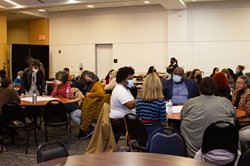
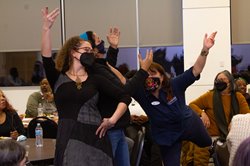
A photo of six round tables, each with folks working together.    Three folks posing with their arms in the air.

The conversation in Memphis centered heavily on the need for more funding—both for individual artists and for arts organizations. Attendees expressed frustration with getting their hopes up when institutions announce intentions to interrupt harmful cycles such as gatekeeping of funding, only to be disappointed when those institutions don't follow through on their promises. While working in a city so well-known for its arts and culture, many felt it was counterintuitive that funding for the arts is not prioritized locally.

Attendees also spoke about making arts education accessible to populations who are living in crisis, and honoring the powerful history that, although often suppressed, is deeply intertwined with local art.
 

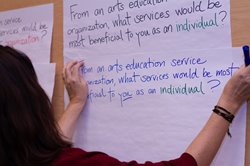
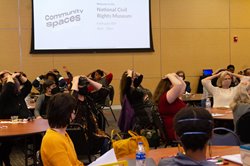
“From an arts education service organization, what service would be most beneficial to you as an individual?” written on a large sheet of paper..   A room full of folks with their hands placed on top of their heads.

Thank you to New Ballet Ensemble & School and Guild trustee Katie Smythe for all your local support, and to April Freeman of Memphis Music Initiative for capturing photos of the event!

Organizational Retreat in Memphis

February 28, 2023

In early February, Guild staff and board members traveled from around the country to Memphis for a five-day organizational retreat. As we gathered in Memphis, we grounded ourselves in place—on land historically stewarded by the Chickasaw and Quapaw Nations, in a city with a rich legacy of arts, culture, and civil rights movement history; as well as in time—during Black History Month, and in a moment when the community’s grief following the police murder of Tyre Nichols is still fresh.

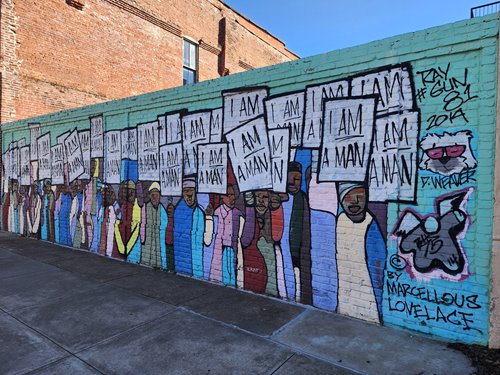
Marcellous Lovelace's mural entitled I Am A Man. It depicts a crowd of people with brown skin, wearing colorful clothing and holding up signs that say "I Am A Man", over a turquoise colored background.

I Am A Man mural by Marcellous Lovelace
 

Our organizational retreat included board meetings, a full-day session with our strategic planning consultants, team building, and staff planning sessions. We discussed the community arts education field and the Guild's place in it, turning our 2023 goals into action plans, as well as board and staff roles & responsibilities.

We also learned about each of our leadership styles and personality types, and how these all fit together to form our organization. Becoming more aware of gives us language to discuss the differences in our working styles, and allows us to better determine how to work with each other and leverage each of our strengths.

Our strategic planning consultants, Heather Heslup and Allegra Brown, led us in a Practical Visioning session in which we discussed what the Guild envisions achieving during the next 3–5 years. The next step for staff and board in our strategic planning process will be to examine our current reality, so that we can figure out how to bridge the gap from here to our vision. Heather and Allegra will also be conducting focus groups with members and stakeholders, as well as a survey open to all in the community arts education field—keep an eye out for more info about how you can contribute feedback towards our strategic planning process.

The retreat concluded with staff collectively mapping out the remainder of the year, taking a realistic look at our capacity, and building new internal systems for project management (including all using the same project management software for the first time! We are thrilled about this). We're excited to be in this next phase of the Portal, where together we are actively shaping the future of the Guild and how we support you!

Thank you to New Ballet Ensemble & School and Guild trustee Katie Smythe for all your local support, and to the Universal Life Building, Halloran Education CenterOrange Mound Arts Council, and Memphis Music Initiative for hosting us in your spaces.

Recent National Tragedies and the Community Space in Memphis Next Week

February 2, 2023

Along with people across the country, we are reeling from the multiple acts of hate and violence against People of the Global Majority in the United States during the past month. We're committed to the collective effort to create a future where mass shootings and police violence are no longer part of our reality. We honor all of the emotions that may be coming up for you in this time, and hope you're able to find some care and ease.

We are reminded that these tragic events directly impact community arts educators and the communities they serve. Community arts education spaces are also often where community members go to process and heal—making this work more important than ever. As part of our Portal process, we’re developing ways to support community arts educators in the wake of tragedies and disasters—more to come.

Following the police murder of Tyre Nichols in Memphis, TN earlier this month, the Guild is mindful of our responsibility to enter communities with consciousness and intention. We will be traveling to Memphis next week for an organizational retreat, a staff & board session with our strategic planning consultants, and an in-person Community Space gathering with local community arts educators.

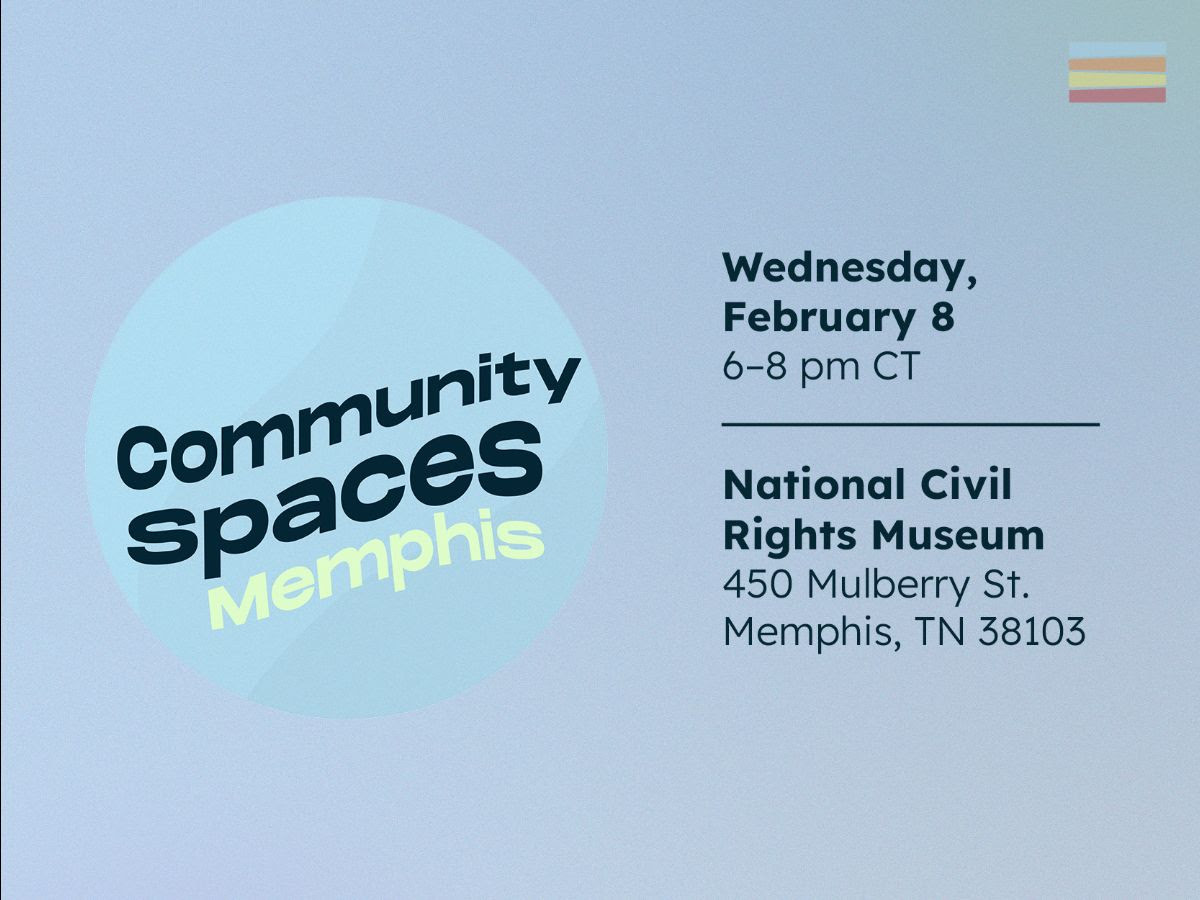
If you are part of the Memphis area community arts education field, we would love to see you at our Memphis Community Space at the National Civil Rights Museum on February 8th (6–8pm CT). We invite you to come as you are, and will honor all that may be surfacing for you right now. There will be space to share what you need and how we can support you—in this moment and beyond. Snacks and wine will be provided. If you have any questions, reach out to us at programs@nationalguild.org.

Community Spaces: Memphis graphic. Wednesday, February 8, 6–8pm CT, National Civil Rights Museum—450 Mulberry St., Memphis, TN 38103

Recap & Recording: 2022 Annual Meeting

January 18, 2023

On December 8th, we held our 2022 Annual Meeting where we shared updates on our Portal of transformation, strategic planning, and plans for the next year. You can watch the full recording here.

One highlight of the meeting was when Executive Director Quanice G. Floyd, with the help of special guest vocalist (and co-founder and Executive Director of Hear Us, Hear Them Ensemble) Jamie Sharp, demonstrated the power of channeling the intense challenges, trauma, and grief of the past few years into song. Quanice spoke passionately about how community arts educators became first responders in their communities during the pandemic, and the essential role that they continue to play.

"In the midst of one of the most trying times in human history, people turned to the arts and arts education to convey their feelings, their hopes, their prayers, their emotions, their wishes.

And your work kept our communities together."

—Guild Executive Director Quanice G. Floyd

The performance served as a representation of why the Guild has entered a transformative period that we are calling the "Portal"—in the context of the new world that we're all living in, we see an urgent need to think critically about how we work, in order to adapt, evolve, and better serve community arts educators as they face today's challenges.

Quanice then shared some of our accomplishments and learnings so far in the Portal, what we've been hearing from the field, and our priorities for 2023. We concluded with our strategic planning consultants, Heather Heslup and Allegra Mercedes Brown, sharing information about the strategic planning process and how community input will be incorporated into the plan. Keep an eye out for more info about an upcoming feedback session for members! 

Watch the recording here.

Board of Trustees Post: Our Story

December 16, 2022

Earlier this year, the Guild entered a process that we called the Portal of transformation. The purpose of this process is threefold: to become more fully aligned with our racial equity principles, policies and values; to continue our historic service and advocacy work while imagining an inclusive organization which reflects the nation’s broad and diverse community arts sector; and to strategically position the Guild for relevance and resiliency into the future.   Transformation or revisioning requires curiosity, a deep commitment to the field of community arts education that we serve, and the willingness to think within a renewal mindset and make bold changes. As Albert Einstein once said, “You cannot solve a problem from the same level of consciousness that created it.” We, the trustees of the National Guild for Community Arts Education, the only national organization dedicated to the growth and sustenance of Community Arts Education, in fulfilling the Guild’s mission and our responsibility to communicate with our members and the field at large, are pleased to share our first transmission about the Guild's re-imagining process and some reasons why this transformation is crucial to the the goals and vision of the organization. 

A number of messages have been transmitted from the organization. We are in the process of realizing a communications strategy to ensure that all transmissions to you are transparent and fully crystallized within the National Guild’s mission and values as we move into a strategic plan and a new, inclusive era of service and advocacy to Community Arts Education in all of its forms and functions.

The appointment of our current Executive Director, Quanice Floyd has been pivotal to this process. Quanice Floyd, a dynamic, enthusiastic and prophetic leader has demonstrated the capacity, imagination and experience to guide us toward the emergent vision of equity, community, leadership and creativity that is foundational for a transformed National Guild for Community Arts Education. We present to you the Guild’s key transformational message in the inspiring words of the Executive Director: “The Guild’s work over the past 85 years has helped us build a strong foundation to support community arts education leaders around the country. After these past two years, we realized that we are on the right track with the “why” but now is the time to expand the “how” we do our work so that we can best adapt to the needs of our community. The only way we can accomplish this is by working collectively together and by seeing humanity in one another. Together, we can strengthen the community arts education ecosystem so that our communities can thrive by removing barriers. We must use our creativity to better not only the community arts education field, but the entire world. The time to do this is now.”

Our 85 years of organizational service and advocacy began in 1937 as the National Guild of Community Music Schools. In 2009 we changed our name to the National Guild for Community Arts Education, to reflect a more inclusive vision of community arts beyond the “music school-based” model, and in 2017 we articulated a new mission—“To ensure all people have opportunities to maximize their creative potential by developing leaders, strengthening organizations, and advocating for community arts education.”

These changes have allowed the Guild to grow from less than 20 member organizations during the first few decades, to over 300 members throughout the U.S. As the Guild expands to include all arts disciplines, populations and types of community organizations, we recognize that to fully realize our mission we need to grow and transition in a manner that is more inclusive, and serves and uplifts communities and organizations which have been historically excluded.  

2015 was a primary turning point in the Guild's history as we embarked on a journey towards a culturally and racially equitable vision. At this time, the values of Equity, Community, Leadership and Creativity were named, and guided the formation of a Board Committee to ensure that our  core values were actualized within the policies, procedures, programming, processes, and actions of the National Guild for Community Arts Education. 

In 2020, the Guild’s Board of Trustees unanimously approved our Racial Equity Guiding Principles and Policies as an addendum to the Guild’s by-laws. In so doing, the Board created a mandate that we consciously shift our focus to include and prioritize communities who have been most impacted by inequity and injustice. 

To midwife a transformation of this magnitude is challenging, since Equity was not a foundational building block for the Guild. Given the dearth of working equity models in the arts (or any organizational sector), the Guild is charged with envisioning and modeling cultural and racial Equity as a reality within the community arts education sector. We seek to shape structures and policies that promote an organizational culture where our energies and efforts are engaged to create an equitable context and climate for everyone we serve. 
 

A New Collective Story 

Our quest is to meet the moment for the nation-wide equitable expansion of community arts education within one of the most racially and culturally challenging times in our country’s history. As the only community arts education organization serving this nation, we seek to expand membership from the center outward, and intentionally serve the people, organizations, and communities that have been excluded from access to the Guild’s programs and services since inception. Member organizations and others, organizations rooted in BIPOC neighborhoods, and teaching artists have shared with us that they need culturally relevant programming, an inclusive membership structure, and full community input and participation to support belonging. Our commitment is to address and remove these barriers, as well as others, as we work with you to create and implement our strategic plan. The Guild intends to take part in the creation of an ecosystem where equity, community, leadership and creativity function dynamically as our collective North Star.

As we bring forth the promise of a new and inclusive National Guild for Community Arts Education, within the community that we continue to serve, intentionally giving priority to racial equity through active inclusion, our work has stirred doubt and anger among some current and former Guild members. For the new story of the Guild to become a reality, we need a shared commitment to working towards a better, more equitable, and more abundant future. 

Our goal and quest is to hear you, inspire you and work with you to build a stronger, more relevant, inclusive and equitable National Guild. Our key organizational messages, highlighting the vision of our Executive Director as well as organizational messages from the Board and Staff will be consistently provided to you, outlining our goals at this juncture and throughout the strategic planning process. We will ensure that our messages to you are clear, transparent, and that they present opportunities to solicit your input, thoughts and ideas as we move forward. One way you can share ideas and questions is by submitting them anonymously using this form

As we move into a strategic planning process, we are thinking big and dreaming about new and inspiring ways to achieve our mission. However, there are some things that will always remain true.  

  • We will always act as a welcoming hub for community arts organizations and artists to convene, learn, and seek support through events, publications, and our website.  

  • We will always advocate on behalf of our field and engage with stakeholders to ensure Community Arts education is valued and resourced.  

  • We will always prioritize leadership development as a critical component of building our field. 

  • We will always be a place for a wide variety of artistic mediums, communities and approaches to Community Arts Education to come together as one field.  

  • We will always be committed to making sure that Community Arts programs are understood as a lifelong right for people of all ages.            

The changes we seek in our organization are rooted in the way we will listen, center and design our programs and services to ensure that those who have been excluded are no longer, and that we will institutionalize and actualize policies, processes and practices in our organization that align with our commitment to equity, power redistribution and restoration. We seek concrete approaches to ensure these commitments are not simply words but result in real action and new ways of doing things.

We, the Guild Board of Trustees and staff commit to showing up consistently, clearly, and creatively within this process. We, the Board of Trustees are a committed group of arts and culture professionals who have dedicated our lives to this field. We deeply honor and value the work of community arts education in all of its forms, for we know that the arts within a social justice framework are key to the success for all of our communities, our children, and our futures. 

Recap: Liberatory Hiring Portal Cafe

December 14, 2022

On November 30th, we held our first Portal Cafe with Guild staff member Ashley Hare, based on their post about liberatory hiring practices. Portal Cafes are virtual opportunities to have a deeper discussion about the learnings and practices that the Guild is developing in the Portal, and attendees are encouraged to bring their own thoughts, questions, and learnings related to the topic.

We used an artful practice to surface things we were wondering or confused about, fears, and hopes related to hiring—and there were many! Some key points and tips that were shared by the collective during the conversation:

  • Ensure that your organization is ready to hire. Sort out compensation, the employee handbook, employee agreements, onboarding processes, etc. before starting the hiring process. Allocate time and resources towards onboarding.

  • Create a realistic and fair position description. Be mindful of how much capacity the position requires, and set the compensation accordingly. Build in room for the person to breathe, vision, and dream. Instead of creating a giant laundry list of things the person will need to be amazing at, lean into a few things they need to be really great at—and a few other things that they need to understand or appreciate in order to work with the team.

  • Make the application clear and simple. Try asking candidates to submit an answer to one question instead of requiring a cover letter, and allowing an option to answer through video. Be clear about compensation in your application.

  • Pay people for their time. Especially if you’re requiring candidates to participate in many rounds of interviews, compensate them for their time to ensure that this isn’t a barrier for your candidates.

  • Build a reciprocal relationship with candidates. Stay in touch with candidates who were not selected, and offer them support in their job search or funds for professional development if you can. Connect them with people in the field who you have relationships with. Keep them in mind for other kinds of opportunities.

  • Set employees up for success. When speaking to references, ask them about what kind of support would make the candidate really successful in a position. Make sure there’s a plan in place to support the new hire in succeeding.

Thank you to all who participated! Together, we can make the practices at our community arts education organizations stronger and more equitable, and make sure community arts educators are being cared for in the way they deserve. Stay tuned for more Portal Cafes on more topics in 2023.

Heather Heslup & Allegra Mercedes Brown selected as Guild strategic planning consultants

November 30, 2022

The Guild is pleased to announce that we’ve contracted Heather Heslup of Pure Art Solutions and Allegra Mercedes Brown of Leadership Development & Learning Design LLC as our strategic planning consultants! Heather and Allegra are Arts/Education Management & Social Justice professionals who specialize in tapping into the creativity of a collective to strategize optimal futures. They have supported various organizations and educational institutions to reach their strategic goals, including the Los Angeles Department of Arts & Culture Arts Ed Collective Program, Arts for Healing & Justice Network, artworxLA, and Turnaround Arts: California.

Heather and Allegra take clients through a strategic planning process that centers humanity, collaboration, and equity. We found alignment with their collaborative process, their racial equity lens, and their commitment to facilitating the dreaming and imagining required to challenge the status quo.

As part of our Portal of transformation, we are embarking on this strategic revisioning through a lens of cultural and racial equity—to be completed in summer 2023. As the sole national service organization existing to support community arts education, we find ourselves at a unique and exciting time which calls for deep and generative listening and dialogue with our constituents and field; thorough examination of our organization internally and externally; and bold dreaming and reimagining to create a fresh new vision that is deeply rooted in our values and our racial equity principles and policies.

Stay tuned! We will invite community in various ways (including more in-person and virtual Community Spaces in the new year) to give input about what you’d like to see and how we can best support you. The feedback gathered will be incorporated into the strategic plan, as well as shared back with community.

Recap: San Francisco & Oakland Community Spaces

November 16, 2022

A group of people standing in a circle, with their hands stretched out in front of them

Guild trustee Nancy Ng smiling and talking at a microphone, with a slide projected in the background that says Community Spaces Bay Area - welcome to the Museum of the African Diaspora  Four people sitting in a circle in conversation with each other - three are sitting on the floor and one is seated on a bench. One person is speaking and gesturing.

San Francisco Community Space at The Museum of the African Diaspora

Last week we held two wonderful Community Spaces in the Bay Area—one in San Francisco (at The Museum of the African Diaspora) and one in Oakland (at Oakstop). Guild trustees Nancy Ng and Sofia Fojas graciously hosted us. 

Some themes that emerged in conversation were the devastating impacts of gentrification and the artist exodus from the Bay Area; the importance of accessibility; the need for policy to support community arts education; the constant struggle to prove the importance and magic of this work in order to get funding, living wages for teaching artists and staff; connections to other types of community services; and much more! Attendees also raised the question of how the Guild can help disrupt the oppressive systems we're all functioning in, especially considering all that the pandemic has exposed. 

Thank you to Pro Bono ASL for providing ASL interpretation, Erica Mones for the delicious food, and photographer Jordan Lewis for capturing the Oakland event.

A person with short black and green hair with two thin braids that hang longer than the rest, standing with their back to the camera and looking at a flipchart paper that says "Thinking about the Guild - what services would be most beneficial to YOU as an individual?"

People sitting around several circular tables, with artwork on the walls in the background  Guild staff member Ivy Young standing and speaking into a microphone, with a screen displaying a slide in the background

Oakland Community Space at Oakstop. Photos by Jordan Lewis