Guild Spotlight: Eepi Chaad of Arts Connect Houston
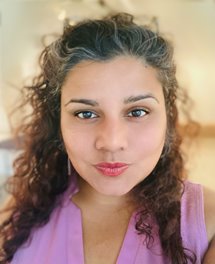
 

Close up of a smiling, tan female of South Asian descent with curly brown hair with grey streaks wearing a pink sleeveless top.Our next Guild Spotlight is Eepi Chaad (she/her), Director of Partnerships & Learning at Arts Connect Houston!

Arts Connect Houston is a collective impact organization, bringing together a collective of 90+ non-profit Arts & Culture partner organizations, leaders at all levels of the Houston Independent School District, local and regional leaders, funders, and community members to ensure that students have access to an arts-rich education.

We recently reached out to Eepi to learn more about how her organization amplifies and connects the people of Houston. Learn more about their collaborative and empowering work below: 


Hi Eepi! Please tell us a bit about yourself, and what motivates the work you do day-to-day.

Hi y’all! My name is Eepi Chaad. I’m a practicing multidisciplinary artist, naturalist, and cultural worker. I’m a Bengali-Texani, a Houston native, and use she/her pronouns. I’m a storyteller at heart. As a creative myself, I am drawn to work as an arts administrator in community arts settings because it brings me joy to make space for expression and provide support for folks as they tap into their own creativity. 


How has community arts education supported in healing and/or meeting the needs of your community? 

I believe that community arts education is the vehicle that brings folks together both in and across communities. Community arts education serves as a gateway to share, bond, and tackle issues that we are experiencing. It is the great connector that makes space for us to see each other as people who may have differences, but at the core are all a part of humanity.
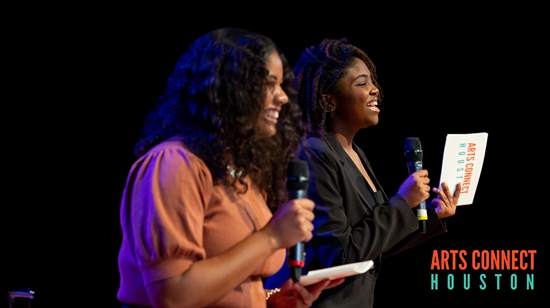
 

A dark background with two Black female high school students on stage holding microphones and smiling during the State of the Arts in Education Symposium, with the words Arts Connect Houston in the bottom right corner.

High school students at the State of the Arts in Education Symposium. Photo Credit: Alex Barber


What are some challenges that your organization is currently facing?

Arts Connect Houston is committed to ensuring that every child in Houston ISD has access to an arts-rich education, which includes having fine arts educators on campuses. Houston is facing the same struggles with teacher shortages as many communities around the country, as well as uncertainty with the future of our largest school district, and concern around funding for the arts and education as a whole.
 

What do you love about the work you do, and/or the community you work in?

Connecting! It is in our name. Art Connect Houston serves as a connector for the arts in the Houston community. Houston is the most diverse place in the country, and it is also one of the largest places. It can be easy to work in silos. Our organization brings together arts and culture workers across organizations, disciplines, and geographic areas to share ideas and work together for a common goal. The icing on the cake of what we do is the numerous collaborations across individuals and organizations that have come from Arts Connect, holding space for cultural workers in Houston to come together.


Sometimes we get so busy in this crucial work that we can forget to take time to recognize the wins and the amazing people that we are surrounded with everyday. Well, we are taking time to lift folks up and celebrate!


Do you have any highlights or stories regarding your work that you’d like to share? 

Two years ago, Arts Connect Houston began holding the State of the Arts in Education Symposium. In addition to sharing a localized snapshot of arts education, we also include an annual Champion Awards, which honors one educator and one community arts leader each year. The Champion Awards serves to acknowledge leaders in our community who have dedicated their careers and lives to increasing equity in arts education. Sometimes we get so busy in this crucial work that we can forget to take time to recognize the wins and the amazing people that we are surrounded with everyday. Well, we are taking time to lift folks up and celebrate!
 

What’s in store for you/your organization for the remainder of this year? What are you looking forward to?

2023 is all about making connections at Arts Connect Houston. We are looking forward to bringing together the community in new spaces and lifting up voices. Arts Connect is looking forward to deepening existing relationships and supporting educators and cultural workers through continued learning opportunities, responsive investments, and by simply providing folks room to come together and collaborate.
 

Lastly, what does community arts education mean to you?

I see community arts education as the tie that binds…and it is all about community. We are stronger together and art is the language that we use to make change in our collective community.
 

An orange to yellow ombre background with the title Arts Connect Houston Arts & Culture Partners in the center surrounded by 90+ Houston arts organization logos.

A collection of Houston arts organization logos that represent Arts Connect Houston's 90+ Arts and Culture partners.


If you'd like to be featured as one of our future Guild Spotlights, then be sure to fill out our interest form! If you have any questions on how to do so, please reach out to nataliavilela@nationalguild.org


Project STEP students and staff featured on the Kelly Clarkson Show

April 12, 2023

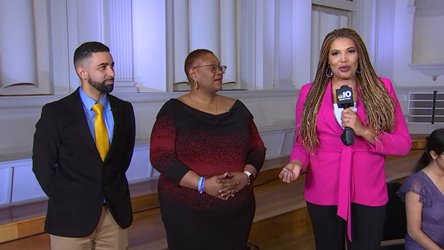
NBC 10 Boston anchor Latoyia Edwards and Project STEP program leaders Mariana and Josué standing next to each other - still from the Kelly Clarkson show.

On April 12th, Guild member Project STEP was featured on the Kelly Clarkson Show.

The show's Good Neighbor of the Year story features Dr. Ian Saunders, the Artistic Director of Project Step in Boston. NBC 10 Boston anchor Priscilla Casper shines a light on how Dr. Saunders and Project Step are transforming the face of classical music by providing underserved kids across Boston with free access to string instruments and lessons with professional orchestra musicians. NBC 10 Boston anchor Latoyia Edwards then joins live from Project Step’s recording studio with program leaders Mariana and Josué to present a special performance of “Sword Dance” by the students of Project Step. Watch the video clip here.

This incredible feature also received coverage in the Boston Globe.

Guild Spotlight: Nancy Kleaver of Dancing Classrooms


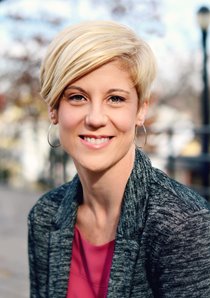
A headshot of Dancing Classrooms executive director Nancy Kleaver. She has short blonde hair and fair skin, and is wearing a pink blouse under a dark gray jacket.Introducing our first-ever Guild Spotlight! We’re excited for this opportunity to continue connecting and sharing with folks within the community arts education field. Throughout this year, we hope to further uplift the community participation, healing, and care that’s embedded within your amazing work, and to amplify its impact on communities nationwide.
Recently we had the pleasure of connecting with Nancy Kleaver (she/her), executive director of Dancing Classrooms! As the largest dance education provider for New York City public schools, Dancing Classrooms also supports an affiliate network of sites around the country, cultivating engaged learners and collaborative leaders through the joyful art and practice of social dance.

Learn more about how her organization amplifies connection, joy, inclusivity, and more through dance on a local and national scale. 


Hi Nancy! Tell us about yourself and your organization.

My name is Nancy Kleaver and I'm the executive director of Dancing Classrooms. I've been the executive director here for about three years, and my entire career has been in community arts education. Coming out of college, I started working at a theater company in upstate New York and developing their school tours and residency programs.  I found my direction. I found my niche, my place. 

Dancing Classrooms loomed large in my understanding of the arts education landscape. The organization is going to be 30 years old next year, and it's probably best known for the documentary film Mad Hot Ballroom, though we've evolved in and do more than what is known from that program today. 

We're the largest dance education provider to New York City public schools. We serve over 15,000 kids just in New York City alone, and also support an affiliate network of ten sites around the country. It's an honor and a privilege to get to lead this company at this time in our history.

Our community is anyone who has always wanted to dance, but never felt brave enough to try.

Where are you located? Who is your community? 

Schools, particularly public schools, are our community. Students who never thought of themselves as dancers before are our community. We have been remote since 2016, 2017; they got rid of their office and studio space before I came on board. Even before the pandemic we were kind of everywhere and nowhere. We have school partners in all five boroughs and other districts in the metropolitan area. Most of the schools we work with have been partnering with us for more than 10 years—some over 20 years—so we have very close relationships with our school partners. We're really proud to see them through changes in leadership, and changes in neighborhood demographics.

Our community is anyone who has always wanted to dance, but never felt brave enough to try. We teach social dance and partner dance—dances that originated and are rooted in cultures and communities for community purposes. I like to think that—I do think, I know this is true because I see it happen—the dances we teach are more accessible than dance with a capital D, with a very serious choreographic vision. We teach dance to build connection and joy, and to create inclusive spaces. That's more important to us than the skills that students take away, and we do a lot of it.


How has community arts education supported in healing and/or meeting the needs of your community? 

We were really moved and touched around this time last year, because of culminating events. We do a showcase with the kids at each school at the end of a residency. It was the first time our school partners had opened up their building to families and their community, and we got to be an integral part of that homecoming. You could just see it in the room: parents there to cheer their kids on, and also super excited to see other parents and teachers and folks they haven't actually seen in person in two years. 

We kept dancing with the kids online, hybrid, socially-distanced. We did every variation you can imagine to keep them moving, and to keep them connected to music and culture and each other. What we heard again and again from the kids is, “I feel better.” “I have more energy.” “I didn't want to be here when we started the class, but by the end of the class, I'm really energized.” 

Dance is the most efficient and effective for student learning right now, because it does all three things: the mind-body-soul connection — it just hits all of those zones. Kids are creating these new neural pathways, and they're more ready to learn. They're more ready to deal with each other. They’re more able to reflect on how they're doing, how they're feeling, and I think we saw that across the board over the last three years. 


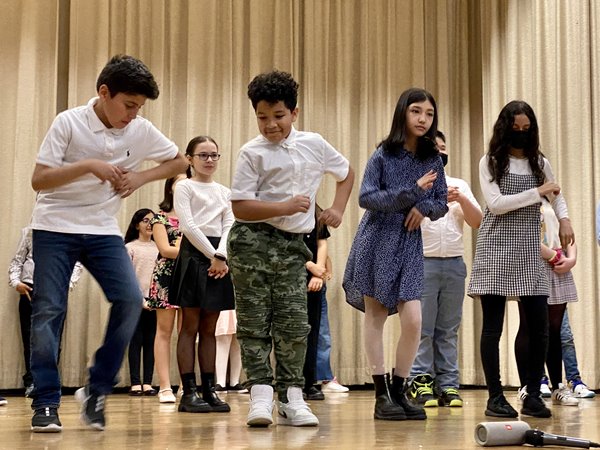
Students at their Culminating Event (PS 175Q) dancing the merengue (March 2022).

Students at their Culminating Event (PS 175Q) dancing the merengue (March 2022). Photo courtesy of Dancing Classrooms.


What are some challenges that your organization is currently facing?

I think there's two: one is kind of a social challenge, and another is financial. I think the social one, which is bigger than us but that I hope we're in a place to help with, is gender inclusion. During the three years that I've been at Dancing Classrooms, we've been going on a journey in truly making our programs gender-inclusive, which is a big deal in a genre that is known to be very normative. We needed to dispel the idea that what we teach is how to be a lady and a gentleman. That's too limiting, and it's not inclusive. So we're really busting those myths through our programs: We walk into a classroom and we just go *points* “1-2-1-2-1-2-1-2.” Everybody dances with everybody in this class. That's always been a part of our program.

Before the pandemic, it was more common that schools would automatically put them in lines — who they thought were boys and who they thought were girls, calling them ladies and calling them gentlemen. We're not doing it that way. When we come to a school, we're really about teaching teamwork and this art form, and understanding the cultural significance of the dances. The kids are growing into compassionate and collaborative human beings. 

With the kids it's working out beautifully, but it takes some uncomfortable conversations with the adults to get there sometimes. And we’re happy to have that, and just hope that through what we’re doing, we can introduce schools to the idea of gender inclusion in a way that’s less scary.

Financially, it’s like every arts organization, especially if you're working with schools, and your business model really relies on school budgets in New York City. I don't think we really know what's coming down the pike with the city budget next year, and the ebbs and flows of money that's available for the arts. This is a constant worry, a constant fear. 


What do you love about the work you do, and the community you work in?

I really love the footprint that our organization is able to have on New York City. Over the last couple of years, we've created a TikTok account, and you can just see it bubble up there: People will post a video of kids dancing, and all these kids from around the city going, “I did that dance!” “Miss Mary! I remember her! I was in that program!” Even just meeting people day-to-day: I tell them I'm from Dancing Classrooms, and they're like, “My kid had Dancing Classrooms at their school!” Teaching artists tell me they bumped into kids they taught on the playground in their neighborhood. Our impact really is there, even if they're not dancers themselves.


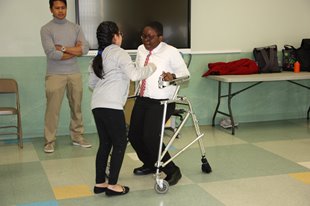
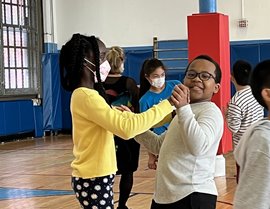
Student with a walking assistance device dancing with another student.   Couple in dance frame in their school gym (PS 1M) during their fall residency.

Left: Student with a walking assistance device dancing with another student. 
Right: Couple in dance frame in their school gym (PS 1M) during their fall residency.
Photos courtesy of Dancing Classrooms.


Do you have any highlights or stories regarding your work that you’d like to share? 

This year, we were able to relaunch an after-school program for kids who really got into partner and social dance, so they can take it to the next level. There’s a student named H* who found out about it somewhere online. H is on the spectrum. He's in middle school and has a hard time making friends. He saw the program and asked his parents about it, and they showed him some videos from Mad Hot Ballroom, and he wanted to do it! 

They took him to the first lesson and, immediately, it was the only thing he would talk about; every day he would ask whether there was another class, and if he could go back. His mom watched the lessons and couldn't believe that, by the third lesson, here was her son dancing with multiple people in the circle, making eye contact each time, and talking to them just spontaneously. She said she had never seen that before; he had never been able to just strike up a conversation. There was something in the space we created, and in the way we danced together that motivated him, and allowed him to feel safe enough to start making friends. There's nothing better than that.


Lastly, what does community arts education mean to you?

It’s art for the people! By the people! It's art that's not created to be sold or bought. It's inclusion. It’s a space of belonging. 


*Name removed for privacy.


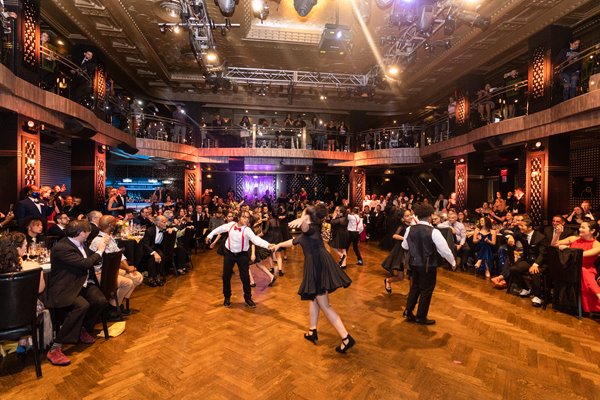
Student performance at Dancing Classrooms' annual fundraising gala MAD HOT BALL 2022 at Edison Ballroom (May 2022).

Student performance at Dancing Classrooms' annual fundraising gala MAD HOT BALL 2022 at Edison Ballroom (May 2022). Photo by Properpix Photos – Victor Nechay.


If you'd like to be featured as one of our future Guild Spotlights, then be sure to fill out our interest form! If you have any questions on how to do so, please reach out to nataliavilela@nationalguild.org


Mural Arts Philadelphia featured on Abbott Elementary

March 16, 2023

An advertisement for the series Abbott Elementary. The photograph is of seven individuals, six of them sitting inside an imaginary school bus and one standing in the middle aisle, wearing a patterned green and yellow dress. The logos for "Abbott Elementary", "ABC6", and "Hulu" are on the bottom-right corner. The logo for "Mural Arts" is on the top-left corner.

Shout out to Mural Arts Philadelphia, who were prominently featured in an episode of the Emmy and Golden Globe-winning ABC series Abbott Elementary! When the show's creator, Quinta Brunson, grew up in Philadelphia in the 2000s, Mural Arts Philadelphia came to her middle school to guide her class through creating a new mural. According to a tweet from Brunson, that childhood experience inspired the March 1 episode of the show, in which Mural Arts comes to the fictional Abbott Elementary to guide the students through designing and creating a mural.

Read more on the Mural Arts website.

Staff Post: Data Considerations

by Claire, our Member Services and Data Systems Manager

March 16, 2023

If you prefer to listen, click here for an audio version of this post.

In 2023 our lives are more online than they've ever been. That means our data, too, is gathered in so many different ways and by countless organizations. I know it frequently gives me pause when I'm asked for information that seems personal or that does not seem aligned or necessary to what I'm trying to accomplish online, so it is perhaps fitting—or ironic—that it’s become an increasing part of my job at the Guild to support our data strategy practices. In the Portal of Transformation, part of my work has been helping to drill deeper into why the Guild uses data: how we collect it respectfully, how we analyze it, and how we use it to inform our work.

To do that, we had to first start with our “why”. There are a ton of reasons for an organization like the Guild to collect information about the folks with whom we engage. One of the reasons for the Portal was to take a step back and to ensure that the Guild’s actions were in alignment with our Racial Equity Guiding Principles and Policies. But to know if we are centering the experiences of those who have been historically marginalized and truly serving all, we need to actually know who that “all” entails, and to make sure that the folks we are reaching represent the full breadth of the community arts education field. For that reason, one specific thing we wanted to make space to review and work on were revisions to the Guild’s demographic survey. For context, at the end of 2021 we began collecting optional demographic data that we hoped could tell us more about who we are serving, while also pointing out gaps in our service. That data asks about race, ethnicity, gender, sexuality, ability, and wealth (or lack thereof), to name a few topics. Knowing who we are engaging, and perhaps more importantly, who we aren’t, helps to keep us accountable to our communities—reminding us that, while being truly inclusive is difficult, it is essential and necessary to our identity and our mission. 

While that survey felt like an important first step, we didn’t expect to get it exactly right on the first try. Since the initial launch of the survey, under the guidance of Ashley Hare, our Deputy Director of Human Development, we have intentionally asked for feedback from survey respondents to help us know what we are getting wrong, what we are getting right, and what we are missing. The feedback we received has been tremendously valuable. Among what we’ve learned is that, as hard as we tried to be inclusive, we occasionally fell short. Some participants questioned our need to gather data about wealth (a controversial heading title in its own right!), feeling like questions around finances were too intrusive. Others asked us why we ask about wealth and property ownership, but not about debt, which was a great question for us to reflect on.

Another challenge we’ve tried to address from the beginning is the balance between affirming people’s identities, while still being able to analyze data quickly and efficiently. Data practices can already feel academic and detached from humanity. When we narrow the scope of choices a survey respondent has in order to more easily report on them it can be painful and limiting, risking potential erasure and compounding harm that has already historically been done to certain communities. To truly accommodate all of the rich and varied ways through which people identify themselves, a demographic survey would ideally have options for open response, where respondents can fill in any information that feels accurate to themselves. But those free response questions can be difficult to aggregate, as they do not yield the easy categories multiple choice questions do. Multiple choice questions are easy to sort through, but they risk us prioritizing certain identities over others, leaving anyone who does not fit a category we have chosen with the dreaded “other” box into which they must squish their apparently-not-mainstream-enough identity. If we truly want all individuals to be welcomed at and served by the Guild, we need to be careful in how we ask for information so as not to cause harm or discomfort. 

It is important for us to commit to using the data we learn about people to benefit those same people—we cannot take without giving back.

While we contemplate our purpose and methodology, we must also do our best to protect respondent data. At a basic level for the demographic survey, that means doing all we can to ensure that data is anonymized by doing things like not capturing IP addresses. Still, as we’ve seen with various data breaches in the past, like the Equifax breach announced in 2017, even the most secure data systems can fail. Fortunately the Guild does not hold any of the attractive data to hackers that an Equifax does, but we’ll still continue to work to minimize that risk. However, it would be irresponsible of us not to acknowledge that the risk exists. 

We also are aware that data collected in good faith now could theoretically be used for less benevolent purposes in the future. In today’s political climate particularly, data is sometimes used in appalling ways that do not match the Guild’s commitment to its communities. In one terrifying example covered in the Washington Post recently, the Texas attorney general requested gender information from the Texas Department of Public Safety, asking how many people had changed their gender on their driver’s license in the past two years. Public Safety complied, going beyond the original request to provide such data from “state ID cards available from birth, learner’s permits issued to those age 15 and up, commercial licenses, state election certificates, and occupational licenses.” This use of data is chilling in a political climate that has targeted transgender people with precision and sought to criminalize and ostracize trans existence. 

Guild records are not public records, of course, and we would never intentionally allow any data we collected to be used in such a harmful way. Still, such stories are heavy on my mind every time the Guild asks anyone to share personal information with us, and we do not want to cause discomfort for respondents worried about sharing too much. 

Our final consideration with data is how we intend to use it. As mentioned above, our primary purpose for understanding the demographics of our community is to ensure that all communities have a place in the Guild. We want to ensure that no one is left out of the Guild umbrella, and in particular, we want to make sure that the programming and member benefits we offer are useful to a wide range of communities, especially those that have been overlooked in the past. For this reason, it is important for us to commit to using the data we learn about people to benefit those same people—we cannot take without giving back. We understand that no one who fills out the demographic survey should be asked to do so solely for the enrichment of the National Guild. 

Knowing how long it takes to do something thoughtfully, intentionally, and reciprocally, it’s no wonder we all have so many questions and thoughts about next steps. To that end, I am curious as to what questions and thoughts you all may have, and I hope you’ll come to our Portal Cafe on this topic on April 13th to discuss and share. I am grateful for the Portal for allowing us space to interrogate our data collection practices to make sure that they align to the Guild’s values, particularly those around anti-racism and access. When the next draft of this optional survey launches later this year and you see it at the end of a registration form for a Guild event, I hope that you will feel comfortable responding, knowing that we are doing all we can to be responsible stewards of the data it produces. 

Guild Receives $25,000 from The Wallace Foundation

March 13, 2023

The Wallace Foundation has awarded the Guild a grant of $25,000 for general operating.

We are happy to continue partnering with The Wallace Foundation, and grateful to members of the philanthropic community who are actively supporting organizational transformation and racial equity work such as the Guild’s Portal of transformation.

Recap: Memphis Community Space

February 28, 2013

The exterior of the National Civil Rights Museum, with a red and white sign with the msueum's name in the foreground, and a clear blue sky in the background.

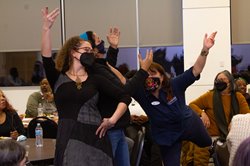
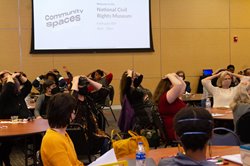
On February 8th, we gathered at the National Civil Rights Museum in Memphis, TN for a Community Space with local community arts educators. This was the fourth in our ongoing series of Community Space gatherings across the country—in the past five months we've visited Boston, San Francisco, and Oakland.
 

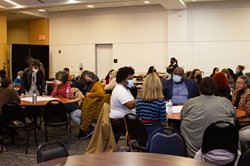
A photo of six round tables, each with folks working together.    Three folks posing with their arms in the air.

The conversation in Memphis centered heavily on the need for more funding—both for individual artists and for arts organizations. Attendees expressed frustration with getting their hopes up when institutions announce intentions to interrupt harmful cycles such as gatekeeping of funding, only to be disappointed when those institutions don't follow through on their promises. While working in a city so well-known for its arts and culture, many felt it was counterintuitive that funding for the arts is not prioritized locally.

Attendees also spoke about making arts education accessible to populations who are living in crisis, and honoring the powerful history that, although often suppressed, is deeply intertwined with local art.
 

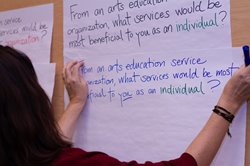
“From an arts education service organization, what service would be most beneficial to you as an individual?” written on a large sheet of paper..   A room full of folks with their hands placed on top of their heads.

Thank you to New Ballet Ensemble & School and Guild trustee Katie Smythe for all your local support, and to April Freeman of Memphis Music Initiative for capturing photos of the event!

Organizational Retreat in Memphis

February 28, 2023

In early February, Guild staff and board members traveled from around the country to Memphis for a five-day organizational retreat. As we gathered in Memphis, we grounded ourselves in place—on land historically stewarded by the Chickasaw and Quapaw Nations, in a city with a rich legacy of arts, culture, and civil rights movement history; as well as in time—during Black History Month, and in a moment when the community’s grief following the police murder of Tyre Nichols is still fresh.

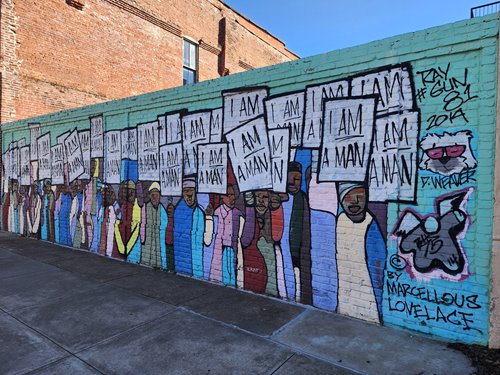
Marcellous Lovelace's mural entitled I Am A Man. It depicts a crowd of people with brown skin, wearing colorful clothing and holding up signs that say "I Am A Man", over a turquoise colored background.

I Am A Man mural by Marcellous Lovelace
 

Our organizational retreat included board meetings, a full-day session with our strategic planning consultants, team building, and staff planning sessions. We discussed the community arts education field and the Guild's place in it, turning our 2023 goals into action plans, as well as board and staff roles & responsibilities.

We also learned about each of our leadership styles and personality types, and how these all fit together to form our organization. Becoming more aware of gives us language to discuss the differences in our working styles, and allows us to better determine how to work with each other and leverage each of our strengths.

Our strategic planning consultants, Heather Heslup and Allegra Brown, led us in a Practical Visioning session in which we discussed what the Guild envisions achieving during the next 3–5 years. The next step for staff and board in our strategic planning process will be to examine our current reality, so that we can figure out how to bridge the gap from here to our vision. Heather and Allegra will also be conducting focus groups with members and stakeholders, as well as a survey open to all in the community arts education field—keep an eye out for more info about how you can contribute feedback towards our strategic planning process.

The retreat concluded with staff collectively mapping out the remainder of the year, taking a realistic look at our capacity, and building new internal systems for project management (including all using the same project management software for the first time! We are thrilled about this). We're excited to be in this next phase of the Portal, where together we are actively shaping the future of the Guild and how we support you!

Thank you to New Ballet Ensemble & School and Guild trustee Katie Smythe for all your local support, and to the Universal Life Building, Halloran Education CenterOrange Mound Arts Council, and Memphis Music Initiative for hosting us in your spaces.

Recent National Tragedies and the Community Space in Memphis Next Week

February 2, 2023

Along with people across the country, we are reeling from the multiple acts of hate and violence against People of the Global Majority in the United States during the past month. We're committed to the collective effort to create a future where mass shootings and police violence are no longer part of our reality. We honor all of the emotions that may be coming up for you in this time, and hope you're able to find some care and ease.

We are reminded that these tragic events directly impact community arts educators and the communities they serve. Community arts education spaces are also often where community members go to process and heal—making this work more important than ever. As part of our Portal process, we’re developing ways to support community arts educators in the wake of tragedies and disasters—more to come.

Following the police murder of Tyre Nichols in Memphis, TN earlier this month, the Guild is mindful of our responsibility to enter communities with consciousness and intention. We will be traveling to Memphis next week for an organizational retreat, a staff & board session with our strategic planning consultants, and an in-person Community Space gathering with local community arts educators.

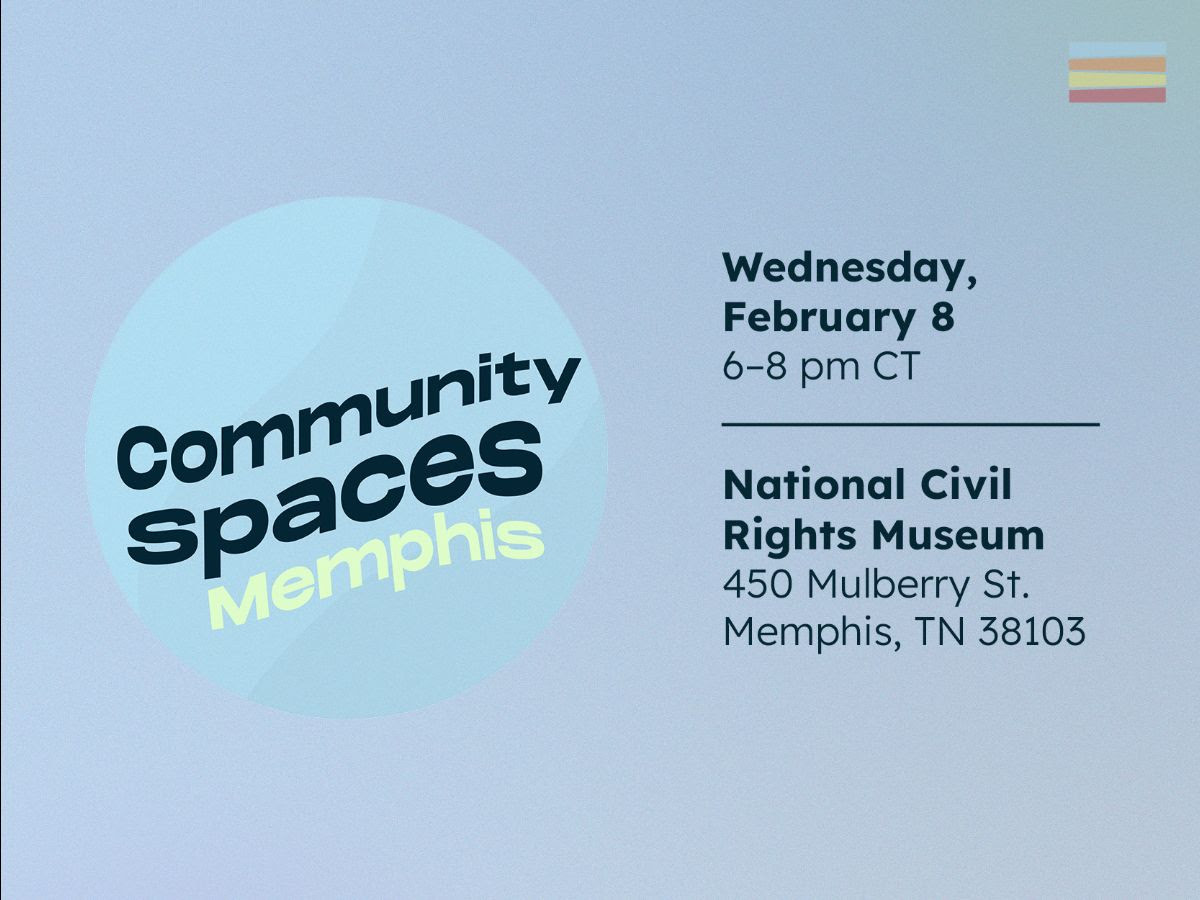
If you are part of the Memphis area community arts education field, we would love to see you at our Memphis Community Space at the National Civil Rights Museum on February 8th (6–8pm CT). We invite you to come as you are, and will honor all that may be surfacing for you right now. There will be space to share what you need and how we can support you—in this moment and beyond. Snacks and wine will be provided. If you have any questions, reach out to us at programs@nationalguild.org.

Community Spaces: Memphis graphic. Wednesday, February 8, 6–8pm CT, National Civil Rights Museum—450 Mulberry St., Memphis, TN 38103

Recap & Recording: 2022 Annual Meeting

January 18, 2023

On December 8th, we held our 2022 Annual Meeting where we shared updates on our Portal of transformation, strategic planning, and plans for the next year. You can watch the full recording here.

One highlight of the meeting was when Executive Director Quanice G. Floyd, with the help of special guest vocalist (and co-founder and Executive Director of Hear Us, Hear Them Ensemble) Jamie Sharp, demonstrated the power of channeling the intense challenges, trauma, and grief of the past few years into song. Quanice spoke passionately about how community arts educators became first responders in their communities during the pandemic, and the essential role that they continue to play.

"In the midst of one of the most trying times in human history, people turned to the arts and arts education to convey their feelings, their hopes, their prayers, their emotions, their wishes.

And your work kept our communities together."

—Guild Executive Director Quanice G. Floyd

The performance served as a representation of why the Guild has entered a transformative period that we are calling the "Portal"—in the context of the new world that we're all living in, we see an urgent need to think critically about how we work, in order to adapt, evolve, and better serve community arts educators as they face today's challenges.

Quanice then shared some of our accomplishments and learnings so far in the Portal, what we've been hearing from the field, and our priorities for 2023. We concluded with our strategic planning consultants, Heather Heslup and Allegra Mercedes Brown, sharing information about the strategic planning process and how community input will be incorporated into the plan. Keep an eye out for more info about an upcoming feedback session for members! 

Watch the recording here.