Youth Leaders Develop Graphics to Emphasize CYD Values

Young artists and activists from RYSE Youth Center (Richmond, CA) and youth leaders from Re:Frame Youth Arts Center (Phoenix, AZ) held a series of conversations to discuss Creative Youth Development (CYD) from 2019-2020. They met over video calls to discuss how they define CYD values, what CYD looks like in practice, and their expectations of adult partners in CYD spaces. A series of graphics emerged from these conversations to help guide adult practitioners and spark larger conversations with youth and adults in the field of CYD.

View the graphics and learn more on the Creative Youth Development National Partnership website.

Robert L. Lynch retires from AFTA leadership amid accusations of hostile workplace, racial inequity

May 27, 2021

It has been more than 5 months since Americans for the Arts' Arts Education Advisory Council, citing racial inequity, lack of accountability, and a hostile work environment, called for Robert L. Lynch and others to be removed immediately from their leadership positions at Americans for the Arts—with support from current and former staff of Americans for the Arts (AFTA) as well as organizations across the field including the Guild. Lynch, who has been on paid leave since December 2020, will now retire. The findings of investigations into the issues of racial inequity and a hostile work environment under his leadership have not been disclosed.

Retired Army Brig. Gen. Nolen Bivens, who has been serving as interim president during Lynch’s leave and is a former board member of AFTA, will replace Lynch as president and chief executive. 

The announcement from AFTA's board states: “Bob has dedicated his life to the arts, in particular increasing access to the arts for everyone, and we know he will continue to be a passionate advocate for many years to come.” 

AFTA’s board hired Proskauer Rose, an international law firm based in New York City, to investigate employees’s claims of a hostile work environment, and the Hewlin Group, a consulting firm for employment issues with offices in D.C., to review its workplace policies and procedures, including those related to diversity, equity and inclusion.

Those investigations have ended, according to the board’s statement. It did not disclose their findings.


Read more on the Washington Post.

EdVestors releases The Arts Advantage: Impacts of Arts Education on Boston Students

May 5, 2021

Supported by The Barr Foundation, The Arts Advantage: Impacts of Arts Education on Boston Students is a longitudinal research study was conducted by Dr. Daniel Bowen (Texas A&M University) and Dr. Brian Kisida (University of Missouri), who have a track record in conducting influential arts education research studies. The study encompasses an analysis of eleven years of arts education data and district data regarding student engagement, school climate, and traditional academic outcomes to examine arts educational impacts for students, and includes over 1,500 variables and 615,000 student-level observations. The ongoing BPS Arts Expansion collaborative effort between the Boston Public Schools, EdVestors, local and national funders, arts organizations, and community members has had remarkable impact. Some highlights from the study’s findings include: 

  • Positive effects on student attendance over the course of a school year, including a reduction in chronic absenteeism
  • Increased levels of student engagement through gains in effort and participation in class, school belonging, and enthusiasm for the arts
  • Higher levels of parent engagement with the school community, their child’s teachers, and being advocates for their school’s improvement

The breadth and depth of the study provides strong empirical evidence to strengthen case-making and inform decision-making around policy matters particularly involving allocation of resources for arts educational opportunities. This study provides a much-needed foundation for future research in arts education and generates new hypotheses for the field that can be utilized in building theory, designing interventions, and guiding future evaluations.

The study was covered in an article in CommonWealth Magazine.

Read the full report here.
NADAC releases first issue of Arts Research Quarterly

April 9, 2021

The National Archive of Data on Arts and Culture (NADAC) has introduced Arts Research Quarterly. Produced in partnership with the National Endowment for the Arts (NEA), Arts Research Quarterly samples recent research publications on the arts ecosystem and on the arts' value and impact for individuals and communities. The literature is based on secondary analysis of arts datasets, whether they are housed at NADAC or elsewhere. 

The first issue spotlights articles and reports on crowdfunding in the arts sector, the impact of the COVID-19 pandemic on the arts and creative industries, motivations and barriers affecting arts engagement, and other topics.

Access the first issue here.

The National Archive of Data on Arts and Culture (NADAC) is a repository that facilitates research on arts and culture by acquiring data, particularly those funded by federal agencies and other organizations, and sharing those data with researchers, policymakers, people in the arts and culture field, and the general public. It is one of several topical archives hosted by the Inter-university Consortium for Political and Social Research (ICPSR), the largest social science data archive in the world and part of the University of Michigan's Institute for Social Research. NADAC is funded by the National Endowment for the Arts (NEA). Thanks to the support from the NEA, users can obtain data from NADAC completely free of charge.

Growing Divides: Historical and Emerging Inequalities in Arts Internships

March 26, 2021

“Growing Divides: Historical and Emerging Inequalities in Arts Internships” is the 11th major research report commissioned by the Strategic National Arts Alumni Project. The report, authored by Alexandre Frenette, Gillian Gualtieri and Megan Robinson of the Curb Center at Vanderbilt University, is a revealing deep dive into the efficacy, popularity and growing inequities that are reshaping what they call the “intern economy".

“Growing Divides” exposes important emerging trends that deserve greater attention and proactive energy from arts schools. Pre-pandemic evidence from SNAAP data suggests that the current conditions will continue to pose particular challenges for women, people of color, and first-generation college graduates. Arts schools’ leadership and policymakers must consider how to ensure a more robust and equitable arts economy for arts students and alumni in a post-COVID-19 context.

Read the full report here.

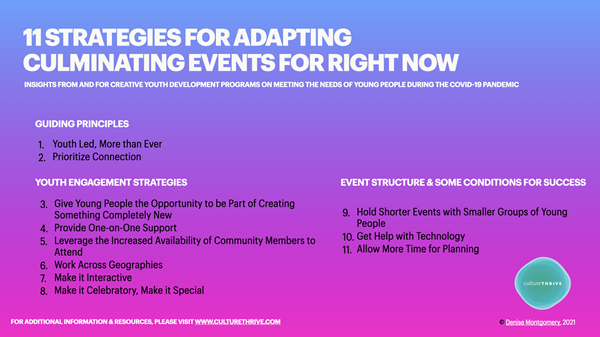
11 Strategies for Adapting Culminating Events During COVID

March 24, 2021
 
Findings From National Study on Adapting Culminating Events in CYD Programs
 
Young people consistently rank culminating events—performances, exhibitions, youth summits, screenings of their films—as a powerful motivator and key aspect of their involvement in creative youth development programs.

Recently-released research from CultureThrive explores how CYD programs are adapting culminating events to the current, largely virtual environments. Findings include the top challenges organizations face, trends in programming and events, strategies for adapting culminating events during the COVID-19 pandemic, and implications for funders. 

 
Find out more on CultureThrive's website.

Some hopeful news is that while organizations face many challenges, including youth engagement; technology and connectivity; and staff capacity and stress, opportunities have emerged with regard to events during the pandemic. Specifically, 58% of organizations reported that, overall, community members have been more available to attend their events. This has included alumni, elected officials, creative industry professionals, funders, and friends, all of which has been engaging for young people. CYD programs also reported significant increases in youth leading events during the pandemic and in youth employment opportunities related to culminating events. Detailed findings from the study are here.


Graphic: 11 Strategies for Adapting Culminating Events for Right Now

NALAC announces 2021 Advocacy Fellows

March 12, 2021

The National Association of Latino Arts and Cultures (NALAC) has announced this year’s cohort of artists and cultural workers participating in its annual Advocacy Leadership Institute (ALI).

With the support of faculty and staff, fellows will participate in a series of preparatory webinars laying the groundwork for a virtual advocacy intensive where fellows will meet with congressional leaders and staff from federal agencies working in cultural policy.

“While they work across various approaches and mediums, this year’s fellows share a commitment to building a more equitable arts field and uphold creativity as a powerful tool for social justice,” said Monica A. Sosa, Program Manager of Leadership Institutes at NALAC.

Learn more about the fellows on NALAC's website.

NASAA Announces $1.46 Million in Grants to Advance Creative Aging

March 4, 2021

In collaboration with Aroha Philanthropies, the National Assembly of State Arts Agencies (NASAA) has announced the award of $1,457,000 in grant funding to 36 state and jurisdictional arts agencies to advance creative aging. Part of NASAA’s Leveraging State Investments in Creative Aging initiative, these grants will expand opportunities for creative aging across the nation, facilitating lifelong learning, joy, social engagement and improved well-being for older adults.

Nineteen of the 36 state arts agencies included consulting, professional development, and program implementation services from Lifetime Arts in their proposals. Lifetime Arts will guide the agencies as they leverage existing state partnerships and forge new ones; develop responsive programming (i.e., veterans in Idaho); form and foster new communities of practice (New Jersey); and train a workforce of hundreds of teaching artists nationwide to develop safe, effective, meaningful, socially engaging, and sustainable programming for older adults.

Read more on NASAA's website.

ChildArt magazine highlights connections between the arts, health, & neuroscience in children

February 26, 2021

In 2020 the National Endowment for the Arts (NEA), in partnership with the National Institute on Drug Abuse (NIDA) at the National Institutes of Health (NIH), contributed to the production of two “special issues” of ChildArt magazine, about the role of the arts in health and childhood development.

Supported by the National Institutes of Health (NIH) and other Federal partners, the ABCD Study® follows nearly 12,000 children beginning at 9–10 years old, who have been enrolled at 21 research sites nationwide. Researchers will study the biological and behavioral development of these children through their teens and early adulthood. The National Endowment for the Arts (NEA) is a federal partner on the study. Questions about arts-engagement are among variables that researchers will examine throughout the duration of the study.

Both issues contain artwork by children and staff involved in the study, as well as articles and interviews showcasing the neuroscientific and health benefits associated with the arts. 

CYD Community Response Survey from The Lewis Prize for Music

February 25th, 2021


The Lewis Prize for Music has created a short survey in an effort to collect information about the creative youth development field's response to the COVID-19 pandemic and the ongoing injustices of systemic racism that the pandemic has magnified.

This effort stems from The Lewis Prize for Music’s belief in—and desire to elevate nationally—the critical work that CYD music organizations are doing to create a more just society. All information shared through the survey will be reported back to the field in a summative fashion and activated toward the goal of increasing resources for the CYD field at large.

You can fill out the CYD Community Response Survey hereThe survey deadline is Friday, March 19, 2021.

You can reach out with questions about this effort to info@thelewisprize.org.