 Published in GuildNotes, this article examines a unique model for capacity building and leadership development, developed by the National Guild and the Pennsylvania Council on the Arts (PCA), and its potential to serve emerging to mid-size culturally-specific arts organizations in states across the country. While this partnership is only one case study, it may provide a model for further solutions that address the unique needs of arts administrators at culturally-specific organizations.
 As Maura O’Malley, co-founder and CEO of Lifetime Arts, puts it: “Aging is something that affects every single one of us. Yet, as a society, we are not adequately prepared to address it.” How can leaders approach this challenge in the coming years? To help answer this question, we spoke to Maura O’Malley about her own journey in creative aging, the cultural shifts in our understanding of positive aging, and the social transformations that need to occur for us to meet the creative needs of older adults in a meaningful way.
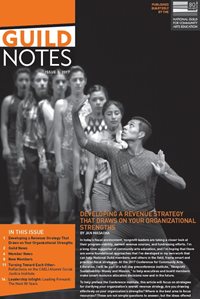 In difficult fiscal environments, nonprofit leaders are taking a closer look at their program viability, earned revenue sources, and fundraising efforts. Jan Masaoka suggests that there are foundational approaches that she has developed in her own work that can help National Guild members, and others in the field, frame smart and practical fiscal strategies. This article will focus on strategies for clarifying your organization’s overall revenue strategy.
 The purpose of benchmarking is to identify best practices and apply them in your organization in order to improve management. This article, which profiles how Settlement Music School used benchamrking as part of an overall strategic planning and capitalization process, explores the role of benchmarking in improving your organization's sustainability.
 “Those looking to serve youth in a holistic way need to place the arts at the center of their overall strategy,” said Lazarre-White during his remarks at the Guild’s Annual Awards Luncheon in Chicago. Only when young people are allowed to tell their stories in a supportive environment—and use their artistic practice to reflect on the world around them—will they be prepared to become agents of change and leaders in their community, he argued.
 The Guild’s three-year experiment with the Teaching Artist Development Track at the annual conference was a quietly bold initiative to advance the teaching artist field. The track was conceived and designed on the strong belief that the field can be changed intentionally and from the grassroots. In this report, Eric Booth discusses the resources and tools that have resulted from this effort.
 In this powerful article, Dr. Bettina Love argues that art, which cannot be produced without moving from imagining to creating, is not only part of the movement, but is the movement at its core. Social change is only possible because of the space that is created when you dream and are moved to create by the possibilities of those dreams. Getting free starts with imagining.
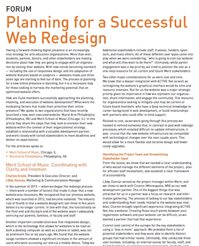 Web redesign projects can be onerous, expensive, and difficult to navigate. In this Forum article, the Guild spoke to three Guild members who have recently undergone successful web redesign efforts. Representatives from Mural Arts Philadelphia, Merit School of Music, and MacPhail Center for Music share their tips and perspectives.
 The Guild’s report, The Practice of Partnership: High-Impact Partnerships with K-12 Schools, details the elements that contributed to successful school partnerships over the course of the Guild’s MetLife Foundation Partners in Arts Education (PIAE) program. This article, an excerpt from the full report, focuses on developing high impact programs through teaching artist (TA) and classroom teacher collaboration, effective professional development techniques, and a focus on TA-student connection.
 Consistent online communication from nonprofits year-round through channels such as social media, blogs, and email newsletters can help cultivate and maintain good relationships with donors, as well as attract new ones. There is no shortage of ways to harness the power of the social web to support fundraising goals, but before you try to utilize all these channels, consider the key ingredient: content.