This webinar is a practical exercise in reviewing program economics through the use of the Program Profitability Model. This unique financial modeling tool will take you out of a "grant budgeting" mindset and offer your organization a clear framework to identify cost savings that may have minimal negative impact on programs, enlist the help of the board and staff in improving finances, tackle operating deficits, incorporate financial considerations within a long-term strategic plan, and ultimately balance mission and finances. During the webinar, we demonstrate how to apply the model to your organization using real-life examples, including an in-depth case study of a nonprofit arts education organization.
Community arts education organizations—with their community roots and partnership potential—are ideal places to launch arts programs for older adults. With this potential in mind the National Guild’s Creative Aging Program, supported by MetLife Foundation, made grants to 38 member organizations between 2008 and 2013 to establish sustained, sequential arts education programs in a variety of visual and performing art forms. Replicable program examples emerged from the grantees. In this article, we explore two distinct program models that can be employed by community arts educators across the country.
In February 2017, nearly 40 experienced creative youth development (CYD) practitioners from Southern California gathered at the Armory Center for the Arts in Pasadena, CA to hear from a panel of cross-sector leaders. The event, hosted by the Creative Youth Development National Partnership, explored opportunities for collaboration between the creative youth development field and adjacent sectors. The key question was: How can CYD and adjacent sectors actively identify shared priorities and break down barriers to effective partnership? This GuildNotes article explores answers to that question.
In 2014, the National Guild, in partnership with 12 other national arts and education organizations, released Arts Education for America's Students: A Shared Endeavor, a joint statement calling on policy-makers and the public to ensure arts education for all students. In this webinar, we explore ways of collaborating and leveraging resources to more deeply engage communities and make better use of our existing assets (teaching artists, certified arts and non-arts educators, etc.). Using the statement as our guide, we explore the complementary roles school and community-based educators can play to create a more favorable arts education environment. We also share information, examples, and ideas on how to overcome some of our existing challenges.
In this webinar, Dr. Ginwright addresses difficult questions about how we heal from trauma and violence in our schools and communities, and presents strategies required to restore a sense of possibility, agency, and action for creative youth development professionals, students, and teachers. The program was hosted by the National Guild's ALAANA (African, Latina(o), Arab, Asian, Native American) Network.
What are the best tactics to use to get donors to say “Yes” to your asks? In this high-energy webinar, Tom Iselin helps you rethink grants and galas, and shows you how you can raise more money with fewer resources and headaches by spending more time raising money in face-to-face settings.
In this slide deck from their highly-rated session at the 2017 Conference for Community Arts Education, founders of peer learning networks in Boston (Youth Arts Impact Network), Seattle (The Creative Advantage), and Philadelphia (Philadelphia Music Alliance for Youth) discuss tools and strategies for success.
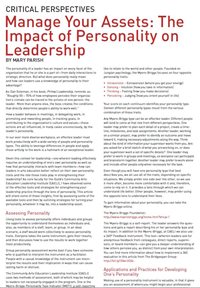 How can leaders in arts education better reflect on their own personality traits and the role those traits play in strengthening their leadership? As core faculty for the Guild’s Community Arts Education Leadership Institute (CAELI), Mary has observed some of the effective tools and strategies for strengthening your leadership practice through the lens of personality. This article will share some of those insights, first by assessing some of the available tools and then by outlining strategies for turning your personality, whatever it may be, into a leadership asset.
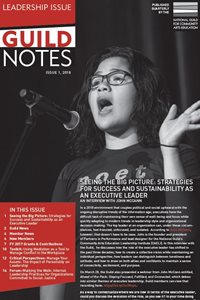 The top leader at an organization can feel frenzied, unfocused, and isolated. According to John McCann, however, that doesn’t have to be case. John is the founder and president of Partners in Performance and lead designer for the National Guild’s Community Arts Education Leadership Institute (CAELI). In this interview with the Guild, he discusses how the role of the executive leader has shifted in the past three decades; how to create a collective vision while maintaining an individual perspective; how leaders can distinguish between loneliness and solitude; and how to draw on both allies and confidants to maintain a sense of connectivity, excitement, and purpose.
 As the field of arts education's focus on social justice continues to grow, what does a commitment to social justice in an organization’s external practices—on-site classes, in-school programs, community outreach—mean for the work that an organization has to carry out internally? How can leaders develop internal policies around staff learning, leadership development, and organizational culture that reflect a holistic social justice commitment? This article focuses on concrete strategies employed by Guild members to realize those goals.