Opera America Awards Opera Minnesota a Civic Practice Grant

Opera America awarded $180,000 to seven companies across the country as part of their first-ever Civic Practice Grants. The awards of up to $30,000 each are supported by Opera America's Opera Fund Endowment and awarded on a biennial basis. In a release, Opera America says the grants are to "support opera companies’ efforts to learn more about civic priorities within their communities, to develop relationships with leading arts and non-arts organizations and their leaders, and to discover and deliver services that strengthen their communities, as well as the visibility and trust of the opera company within it." 

Minnesota Opera, a Guild member, was among the seven projects funded. Funding from Opera America will go to build its capacity to develop a civic practice with the local Hmong-American community. Through a conversation series co-created with project partners, the company will listen and learn what are the pressing needs of this community and what of its own expertise and resources might be a support.

Other funded projects include the Chicago Opera Theater, Houston Grand Opera, Lyric Opera of Chicago, Opera Omaha, San Francisco Opera and The Santa Fe Opera. 

Read the full release here.

Guild Members Awarded 2019 National Endowment for the Arts Grants

The National Endowment for the Arts announced recipients of over $27 million in 2019 grant funding this week, awarded to grantees in all 50 states, Washington, D.C., and Puerto Rico. The grants are awarded to further the Endowment's goal to provide all Americans with the opportunity to participate in and experience the arts. 

The awards announced represent three of the NEA's funding categories: Art Works and Challenge America to support projects by nonprofit organizations, and Creative Writing Fellowships. Through these grants, the National Endowment for the Arts "supports local economies and preserves American heritage while embracing new forms of creative expression."

Thirteen Guild members were among the winners, awarded a total of $420,500 to provide arts education and programming in their communities across the country. Congratulations to the grantees on their hard work! If you are a 2019 NEA grantee and not listed below, please contact Sabine at sabinebernards@nationalguild.org to be added to the list. 

Read the full release here.


2019 Guild members awarded NEA grants:

ART 180

$10,000 | Richmond, VA

To support after-school arts programming for teens from underserved communities.


Arts Corps

$35,500 | Seattle, WA

To support a multidisciplinary arts education program for Seattle youth from underserved communities


Big Thought

$100,000 | Dallas, TX

To support Dallas City of Learning (DCOL), a collective impact project


Campanile Center for the Arts

$10,000 | Minocqua, WI

To support a concert performance and related outreach activities in rural Wisconsin.


Center of Creative Arts

$40,000 | Saint Louis, MO

To support a dance outreach program for youth from underserved communities.


Cleveland Play House

$15,000 | Cleveland, OH

To support training and mentorship activities for emerging theater leaders in artistic direction and theater management.


Creative Action

$50,000 | Austin, TX

To support creative youth development programs for teens in film, theater, and visual arts.


Destiny Arts Center

$15,000 | Oakland, CA

To support performing arts instruction for students.


Flower City Arts Center

$10,000 | Rochester, NY

To support an artist-in-residence program for visual artists.


Minnesota Opera

$50,000 | Minneapolis, MN

To support the world premiere and additional performances of The Fix, a new opera by Composer Joel Puckett and Librettist Eric Simonson.


New Urban Arts

$15,000 | Providence, RI

To support an arts mentorship program for underserved high school students.


Philadelphia Young Playwrights

$15,000 | Philadelphia, PA

To support the Core Playwriting Program.


Project STEP, Inc.

$55,000 | Boston, MA

To support an intensive string music training program for youth.
Karen Deschere, Executive Director of Wharton Institute for the Performing Arts, Passes Away

Karen Deschere passed away after a long battle with cancer on January 11, 2019. A lifelong music lover, Karen devoted herself to her work in the arts across the country, including serving as the Executive Director of the Hudson Valley Philharmonic; Managing Director for Education at the Grammy Foundation in Los Angeles; Executive Director of the Chicago Symphony Chorus and Civic Orchestra of Chicago, adjuncts of the Chicago Symphony Orchestra;  President and Chief Executive Officer of the  Wisconsin Conservatory of Music in Milwaukee; Education Director at Boys and Girls Harbor in Harlem. Most recently, Karen served as the executive director of Wharton Institute for the Performing Arts in New Jersey since 2014. 

In a memorial post, Wharton remembered Karen's "love for music and her deep commitment and undying passion to change lives through music." Outside of work, Karen sang in many church choirs wherever she moved across the U.S. 

Karen was both a respected and loved member of the National Guild member community as well as a participant in the 2017 Community Arts Education Leadership Institute (CAELI). Those who participated in the program with Karen remember her generosity, kindness, and passion for arts leadership. She will be missed by many; the Guild and our community are thankful to have had Karen’s voice and leadership over these many years.

A memorial service celebrating Karen’s life will be held on February 9, from 11 AM – 1 PM at The First Presbyterian Church in the City of New York,  48 Fifth Avenue (Between 11th and 12th Streets), NYC 10011

In lieu of flowers or other tributes, contributions may be sent to The Karen Deschere Fund for Excellence at Wharton Institute for the Performing Arts, 60 Locust Avenue, Berkeley Heights, NJ 07922.

Read the full release from Wharton here.


Lisa Fiorentino Named Chief Executive Officer of Indian Hill Music

Indian Hill Music (Littleton, Massachusetts), a non-profit center for music education and performance, has named Lisa Fiorentino as its chief executive officer. Fiorentino has been at Indian Hill Music for 10 years, most recently as the organization's chief operating officer. She is stepping into the chief executive officer role as Susan Randazzo, co-founder and current executive director, is transitioning into a role focusing on long-term institutional advancement. 

Indian Hill Music is currently in the process of creating a world-class education and performance center on 110 aces in Groton, Massachusetts, which will be home to a 1,000 seat concert hall, a 300 seat recital hall, rehearsal and recital spaces, and a lawn for summer concerts. Slated to open in 2022, the Music Center will be a regional gathering place for music education and performances in Central Massachusetts and beyond. 

We have an extraordinary opportunity to create one of the most ambitious cultural projects in New England," Fiorentino says, "a world-class music center for teaching, performance, and community partnership. Our organization provides exceptional and vibrant music experiences that educate, energize, and enrich our community. I look forward to working with Indian Hill’s outstanding team of staff, faculty, musicians, and board members to deepen our impact in the region.”

Read the full release and learn more about Indian Hill Music.

Philadelphia Music Educators Attend Professional Development Day Hosted by Members

The Philadelphia Music Alliance for Youth—which consists of nine partner organizations including Guild members Settlement Music School, Play On, Philly!, and Temple Univiersity Music Preparatory Division—and the School District of Philadelphia's Office of the Arts & Academic Enrichment collaborated to host the first ever shared professional development day on January 18. The free event drew 252 music education teachers from local cultural organizations as well as district music educators in an effort to align, enrich, and expand music education opportunities for students across the city. 

Attendees heard from Nicole Robinson, creator of Cultural Connections by Design, a music educator with a special interest in working with urban school districts. Breakout sessions focused on topics ranging from building relationships with students, the importances of emotional health and career longevity, and coding in the music classroom. 

Read more about the event here.

Carnegie Hall’s Play USA Eligibility Forms Open February 1

Carnegie Hall's Play USA program supports partner organizations across the country with funding, training, and professional development for teachers and arts administrators working to offer instrumental music education to low-income and under served K-12 students. 

Application forms open February 1, and are due March 15. Partners will be announced June 28. Read more here. 

RAW Art Works Student Awarded Full College Scholarship

RAW Art Works (Lynn, MA) Reel to Reel Film School student Michaela Olabisi has been awarded the Questbridge National College Match Scholarship to attend Vassar College in the fall. The scholarship, which covers her full tuition, helps low-income, first generation students get into and attend prestigious schools. 

Michaela has been involved with RAW since eighth grade, and says she does not think she would be where she is today without the after-school arts organization. Through their Reel to Reel Film School, they engage students in the art of visual storytelling through the process of making a film. Michaela's film, "The Missing Element," is a film highlighting the lack of acknowledgment towards people of color in the STEM field.

Read the full story here. Learn more about Reel to Reel Film school here, and watch Michaela's video here.

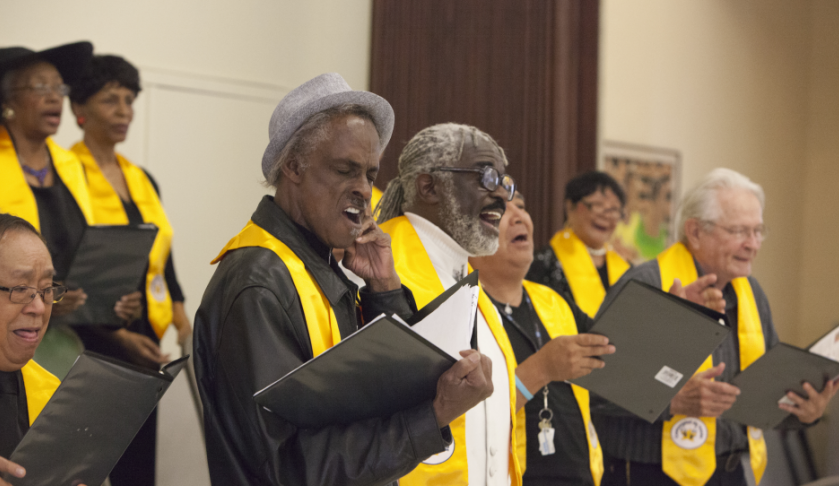
Groundbreaking SFCMC Study Explores Impact of Community Choir on Older Adults

The San Francisco Community Music Center (SFCMC), in collaboration with UC San Francisco and the San Francisco Department of Aging and Adult Services, has completed the Community of Voices Trial. The study, funded by a five-year grant to UCSF from the National Institute on Aging of the National Institutes of Health, aimed to examine whether singing in a community choir is a cost-effective way to promote health and well-being among culturally diverse older adults. The results have now been released in the Journal of Gerontology: Psychological Sciences, as well as being shared publicly on the Community of Voices Website.

“We hear from our older adult choir members all the time how singing in the choirs lifts their spirits, but it’s wonderful to get this confirmation from a research study about the impact of singing in a choir for older adults. We are grateful to UCSF and Julene Johnson for their work on this,” comments Julie Rulyak Steinberg, executive director, Community Music Center.

The study followed twelve community choir groups made up of 390 socioeconomically and racial/ethnically diverse adults aged 60 and over. Led by professional choir directors and accompanists, choirs practiced and performed music that was culturally specific to each community and appropriate for older adults with varied singing and music-reading abilities. Researchers examined the physical, cognitive, and psychosocial impacts on choir members by measuring health and wellbeing outcomes including memory, cognition, feelings of loneliness, and interest in life.

Researchers found significant improvements in loneliness and an interest in life for older adults who sang in a choir for six months. There were no substantial differences in cognitive ability, physical outcomes, or health care costs. “We were a little surprised not to see improvements in cognitive and physical function, especially because the literature, although small, suggested there should be improvements,” said lead author Julene Johnson, PhD, associate dean for research and professor in the UCSF School of Nursing. “However, our study is one of the first randomized controlled trials of a choir intervention, whereas the others were cross-sectional or did not randomly assign the participants.” More research is needed on how choirs improve well-being and the potential long-term health impacts, said Johnson.

With an aging population and a lack of social systems to adequately support them, the risk for social isolation, depression, and loneliness is older adults is high. Community choirs represent one creative and accessible approach to engage older adults in the arts because they are low cost to deliver, engaging, and can be culturally tailored to each community.

You can read the full press release here, and access the Community of Voices Study Choir Program Manual here for a guide to creating a community choir for older adults.

South Shore Conservatory Announces New Parkinson’s Chorus

South Shore Conservatory (SSC) announced recently the creation of Singing with Parkinson’s, a chorus designed for individuals living with Parkinson's disease and their care partners. This new chorus, a partnership between SSC and the South Shore YMCA, is supported by a grant from the American Parkinson Disease Association, MA Chapter. The first session starts Wednesday, January 16 at the Laura Center for the Arts, South Shore YMCA, 97 Mill Street, Hanover.

“SSC is excited to partner with the South Shore YMCA to bring the first specialized chorus of this type on the South Shore,” said Kathy Czerny, SSC president.  “For years, we have witnessed the power music has to touch all populations, and we hope this weekly musical interlude serves to brighten the lives of all who participate.”

Research shows that those participating in organized music groups experience a sense of belonging.  This is especially meaningful to those dealing with a progressive disease, which can be isolating. Neurologically, music affects the brain and muscles in a way that allows individuals to use their voice and move their bodies more effectively and powerfully. In addition, the structure of music and its ability to re-circuit in our brains when areas shut down, provides opportunity for individuals living with Parkinson’s to address multiple symptoms in a fun and social way.  Singing in a chorus provides patterns, practice habits, and social engagement, designed to maintain not just skills, but quality of life.

Learn more about SSC and the program here.

Settlement Student on How Piano Changed Their Life

Jennifer Weiner, author, NYTimes contributor, and student at Settlement Music School, recently published a column on how playing the piano—and being mediocre at it—has helped her to embrace failure. After publishing an essay collection that did not receive the critical reception she had hoped for, Weiner sought ways to grapple with disappointment. She found an instructor at Settlement and began practicing every day.

"My teacher was a genial man with white hair and an encyclopedic knowledge of all things musical, from the lives of composers to exactly how many versions of a Chopin nocturne were found in his desk after he died," Weiner writes. "After six months, I purchased a keyboard with all 88 keys. After nine months, I found a free piano on Craigslist. Now, a year into my second stint as a piano student, I can proudly announce that I am … still pretty terrible. Except playing the piano has accomplished what all that yoga and meditation never could. I can quiet my mind and focus entirely on something: not my breath, but the music."

Ultimately, she has found comfort in a task that she will never be great at—but loves nonetheless. "In the new year, I will embrace the joy of making music (loosely defined) only for myself. I will invite failure into my life and play without the expectation of being the best, or even mediocre, until failing isn’t a terrifying unknown but just another possibility, and one I can survive."

You can read the full article here.