Guild Spotlight: Asiyah Kurtz of Camden FireWorks
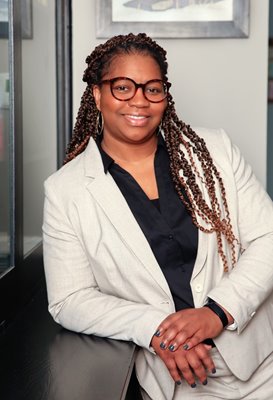
a brown woman with glasses and shoulder-length braids poses wearing a tan suit and black shirtOur next amazing Guild Spotlight is Asiyah Kurtz (she/her), executive director of Camden FireWorks! Get to learn more about how Asiyah and this New Jersey-based art gallery have uplifted creatives of multiple identities and artistic practices, empowering the community of Camden in the process. 


Hi Asiyah! Please tell us a bit about yourself, and what motivates the work you do day-to-day.

I am a quilter, applied anthropologist, and mom of three amazing humans and two pups. I was born in Memphis, TN but have been in New Jersey for the last seven years. As Executive Director of the only independent art gallery in Camden, NJ (Camden FireWorks), I am able to pair my work as a fiber artist and culture worker in collaboration with local artists.

What motivates the work I do is the people with whom I work. In a city with fewer economic resources, I have found that the social capital runs deep and allows artists to continue sustaining their work despite structural challenges. I am proud to be working in community with Camden artists.
 

Where are you located? Who is your community?

I work in Camden, New Jersey and live just a few miles from where I work. Because the definition of community is contextual, I would define my work community as self-taught artists who live or work in Camden. This would include artists from traditional disciplines as well as those from who are folk artists and culture bearers with deep generational knowledge.

In a city of 78,000 people with no grocery or artist supply store, we are intentional about providing opportunities for creative expression. Community arts education has helped us to strengthen the connective fiber of social cohesion with our community and has enabled us to highlight cultural traditions that embrace our full humanity. 

How has community arts education supported in healing and/or meeting the needs of your community? 

At Camden FireWorks, we view art and art-making as a communal right. In a city of 78,000 people with no grocery or artist supply store, we are intentional about providing opportunities for creative expression. Community arts education has helped us to strengthen the connective fiber of social cohesion with our community and has enabled us to highlight cultural traditions that embrace our full humanity. 

For example, our exhibitions have allowed us to show art as a healing practice in the work of Renata Merrill who used quilting to heal from a brain tumor, Quinton L. Greene (a veteran who employed painting to help with PTSD), and Brittany Anne Baum who used oil portraiture to emotionally heal from heartbreak.
 

What are some challenges that your organization is currently facing?

As with most post-pandemic arts organizations, we are facing continual financial pressure to provide art and art-making opportunities in a city where the median income is well below the poverty line. We sorely need general operating support that helps us to sustain the work we do well and the relationships we have developed.

What do you love about the work you do, and/or the community you work in?

What I love most about the work I do is that we have the unique opportunity to meet people who are marginalized within the arts. Whether a person from the LGBTQ community or a BIPOC artist, we uphold their life experiences and artistic practices as valued and valuable to the community as a whole.
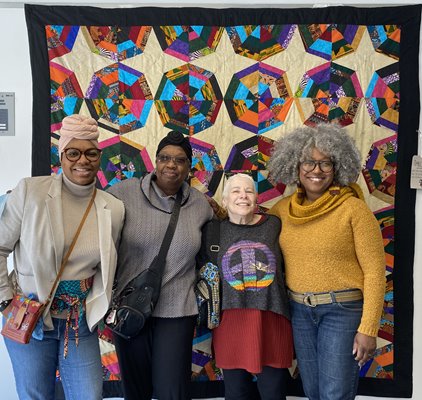
 

three black women and one white woman pose in front of a multi-colored quilt

Photo courtesy of Camden FireWorks

Do you have any highlights or stories regarding your work that you’d like to share? 

We recently launched a curator initiative that allows us to identify, partner with and provide competitive pay to artists who have never curated a gallery exhibition. Our program allows us to build the individual practices of emerging curators from diverse communities using a collaborative research approach and in-depth professional development. We have already had much success with this initiative and have committed 50 percent of our exhibition calendar to emerging curators.

What’s in store for you/your org for the remainder of this year? What are you looking forward to?

Camden FireWorks is looking forward to expanding our base of operations by adding more studios for artists to rent as well as establishing a new pottery village. We are also working to create a public art program which we believe will positively change the art landscape in Camden for generations to come.

Lastly, what does community arts education mean to you?

To me, community arts education means the opportunity to reach people using art regardless of their ability, experience or skills. Fundamentally, community arts education is about, for, and with artists at all levels.
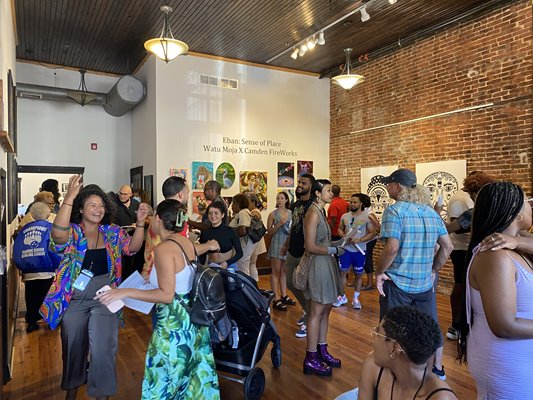
 

Dozens of people of varying race, ethnicity and gender celebrate an art exhibition at Camden FireWorks

Photo courtesy of Camden FireWorks


If you'd like to be featured as one of our future Guild Spotlights, then be sure to fill out our interest form! If you have any questions on how to do so, please reach out to nataliavilela@nationalguild.org


Guild Spotlight: Eboni Wyatt of Urban ArtWorks


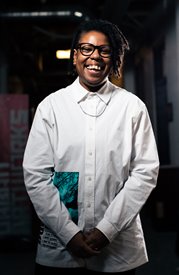
A headshot of a brown skinned nonbinary person with dreadlocks, looking into the camera with a big smile. They are wearing a white collared shirt, silver necklace and black rimmed glasses. Their dreadlocks are to the side of their face.Introducing our newest Guild Spotlight, Eboni Wyatt! Get to learn more about Eboni (they/them) and their experience at Urban ArtWorks in building community, empowering youth, and creating pathways through the transformative and healing power of art.


Hi Eboni! Please tell us a bit about yourself, and what motivates the work you do day-to-day.

My name is Eboni Wyatt and I am the Program Director at Urban ArtWorks. I oversee the planning and implementation for our youth programs. I've been working with youth and young adults for over ten years, and I have a personal artistic practice based in film photography, zines and prose. I'm passionate about building community, especially around the intersections of art and activism. I graduated from Georgia State University with a Bachelor of Arts in Sociology, focusing on race and urban studies in 2013. I then spent four years in San Diego, CA working at the University of San Diego where I helped manage and develop various youth programs, then directed an after-school program for a charter school.

Every day I am motivated by the energy our youth bring to our art studio and their dedication to our programs. The way our youth think creatively and challenge themselves and each other in growing their artistic abilities is inspiring. The barriers that they overcome in small and big ways through our program encourages and drives me to continue doing this work. Watching our young people find community and discover their passion to make art keeps me going.


Where are you located? Who is your community?

Our organization is based in Seattle, Washington but serves all of King County. Our community is made up of artists, muralists, youth, art administrators, teaching artists and volunteers. I'm proud to work for an organization that is diverse, values anti-racism and supports emerging and BIPOC artists and muralists.
 

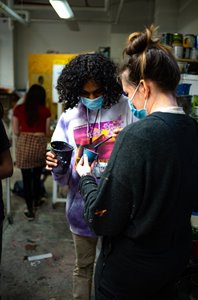
One brown skinned youth with black curly hair, and one white woman with brown and blonde hair in a bun are holding containers of paint, mixing colors. They are in a dimly lit art studio environment with concrete floors.

Photo courtesy of Urban ArtWorks
 

How has community arts education supported in healing and/or meeting the needs of your community? 

With our youth programs we prioritize working with teens who face barriers to the arts and creating pathways for them to become the future muralists, teaching artists or staff within our organization. Our youth programs provide stipends for each youth participant to honor and show that we value art as work and labor, and in hopes that their stipends support any financial barriers they face. We focus on building community and helping youth overcome the challenges they face by exposing them to the transformative power of art. 

Some of our projects have focused on helping communities heal from gun violence and the loss of a community member. We helped youth transform a place of violence to instead celebrate the many cultures within that community and take a stand against the violence happening around them. And most recently we worked with a group of students to help them grieve the loss of a classmate by coming together through art and memorializing their friend in a mural.


What are some challenges that your organization is currently facing?

As we've grown, our programmatic reach has expanded. We have more and more youth coming to us from south Seattle and King County. We've identified that transportation is a challenge for many of these youth to access our programs. We're doing our best to break this challenge and hope to set up year round programming in these areas to work with more youth where they are located to break that barrier.
 

I love that I am working in a community where I am surrounded by artists of all ages and walks of life. Working and being in community with artists with different styles and mediums has challenged me to take my personal art practice more seriously and helped me own that I too am an artist.

What do you love about the work you do, and/or the community you work in?

My personal value of using art as a tool for activism and social change is honored and valued at Urban ArtWorks. I love that I am able to work at the intersections of art and social justice. In addition, as an artist myself, I love that I am working in a community where I am surrounded by artists of all ages and walks of life. Working and being in community with artists with different styles and mediums has challenged me to take my personal art practice more seriously and helped me own that I too am an artist.

Do you have any highlights or stories regarding your work that you’d like to share? 

My first summer working with the organization, I worked with a youth participant who just wanted to know how he could make the most money with his art. Over that summer and him then joining our mentorship program, he was really exposed to how impactful public art can be and the importance of working with community. This is a direct quote from their artist bio, "In the past two years, I realized that I no longer aspire to sell my art to fine art galleries and the upper class, instead I plan to pursue public art to allow more people access."

What’s in store for you/your org for the remainder of this year? What are you looking forward to?

I'm looking forward to continuing to grow our Mural Apprentice Program and Base Crew mentorship program. We've been making new partnerships to provide year round programs in other parts of the county, so I'm excited to see our geographic reach expand. This summer we are providing 6 programs, and I'm really excited to see what our young people create, the connections they'll make and see them thrive in creative community with their peers. 

Personally, I'm looking forward to completing a zine commission for a Black arts organization in Seattle, connecting with more artists in my community and completing a few personal film photography and zine projects.

Lastly, what does community arts education mean to you?

Community Arts Education to me means supporting creative curiosity and discovery, through experimenting with various mediums.


If you'd like to be featured as one of our future Guild Spotlights, then be sure to fill out our interest form! If you have any questions on how to do so, please reach out to nataliavilela@nationalguild.org


Mosaic Youth Theatre of Detroit culminates 30th Anniversary season with “Alice & the New Wonderful”

May 21, 2023

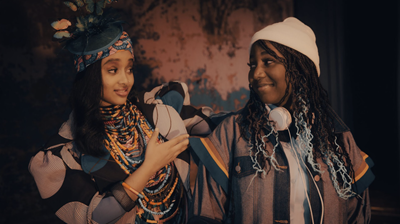
Two young people looking at each other, one with light brown skin wearing colorful jewelry and clothing, and one with brown skin wearing a beanie hat and headphones around their neck.

Congratulations to Guild member Mosaic Youth Theatre of Detroit, who received coverage in The Michigan Chronicle ahead of their May performances of “Alice & the New Wonderful”, by award-winning playwright Idris Goodwin, at the Detroit Institute of Arts Film Theatre. This marks their 30th Anniversary season. There's a great series of blog posts on their website sharing a behind-the-scenes look at production!

“This production is the manifestation of seeds planted in the winter of 2019. We began our journey down the “rabbit hole,” discussing and writing music based on the themes in Carroll’s Alice in Wonderland. The world took many twists and turns in 2020, which caused us to have to wait to tell this story. We are so excited to finally share it with our community,” said DeLashea Strawder, Executive & Artistic Director of Mosaic Youth Theatre of Detroit.

Guild Spotlight: Eepi Chaad of Arts Connect Houston


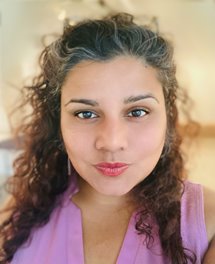
Close up of a smiling, tan female of South Asian descent with curly brown hair with grey streaks wearing a pink sleeveless top.Our next Guild Spotlight is Eepi Chaad (she/her), Director of Partnerships & Learning at Arts Connect Houston!
Arts Connect Houston is a collective impact organization, bringing together a collective of 90+ non-profit Arts & Culture partner organizations, leaders at all levels of the Houston Independent School District, local and regional leaders, funders, and community members to ensure that students have access to an arts-rich education.

We recently reached out to Eepi to learn more about how her organization amplifies and connects the people of Houston. Learn more about their collaborative and empowering work below: 


Hi Eepi! Please tell us a bit about yourself, and what motivates the work you do day-to-day.

Hi y’all! My name is Eepi Chaad. I’m a practicing multidisciplinary artist, naturalist, and cultural worker. I’m a Bengali-Texani, a Houston native, and use she/her pronouns. I’m a storyteller at heart. As a creative myself, I am drawn to work as an arts administrator in community arts settings because it brings me joy to make space for expression and provide support for folks as they tap into their own creativity. 


How has community arts education supported in healing and/or meeting the needs of your community? 

I believe that community arts education is the vehicle that brings folks together both in and across communities. Community arts education serves as a gateway to share, bond, and tackle issues that we are experiencing. It is the great connector that makes space for us to see each other as people who may have differences, but at the core are all a part of humanity.
 

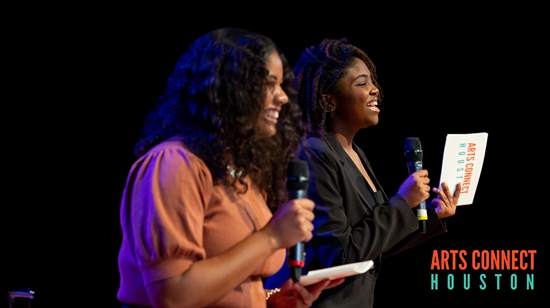
A dark background with two Black female high school students on stage holding microphones and smiling during the State of the Arts in Education Symposium, with the words Arts Connect Houston in the bottom right corner.

High school students at the State of the Arts in Education Symposium. Photo Credit: Alex Barber


What are some challenges that your organization is currently facing?

Arts Connect Houston is committed to ensuring that every child in Houston ISD has access to an arts-rich education, which includes having fine arts educators on campuses. Houston is facing the same struggles with teacher shortages as many communities around the country, as well as uncertainty with the future of our largest school district, and concern around funding for the arts and education as a whole.
 

What do you love about the work you do, and/or the community you work in?

Connecting! It is in our name. Art Connect Houston serves as a connector for the arts in the Houston community. Houston is the most diverse place in the country, and it is also one of the largest places. It can be easy to work in silos. Our organization brings together arts and culture workers across organizations, disciplines, and geographic areas to share ideas and work together for a common goal. The icing on the cake of what we do is the numerous collaborations across individuals and organizations that have come from Arts Connect, holding space for cultural workers in Houston to come together.


Sometimes we get so busy in this crucial work that we can forget to take time to recognize the wins and the amazing people that we are surrounded with everyday. Well, we are taking time to lift folks up and celebrate!


Do you have any highlights or stories regarding your work that you’d like to share? 

Two years ago, Arts Connect Houston began holding the State of the Arts in Education Symposium. In addition to sharing a localized snapshot of arts education, we also include an annual Champion Awards, which honors one educator and one community arts leader each year. The Champion Awards serves to acknowledge leaders in our community who have dedicated their careers and lives to increasing equity in arts education. Sometimes we get so busy in this crucial work that we can forget to take time to recognize the wins and the amazing people that we are surrounded with everyday. Well, we are taking time to lift folks up and celebrate!
 

What’s in store for you/your organization for the remainder of this year? What are you looking forward to?

2023 is all about making connections at Arts Connect Houston. We are looking forward to bringing together the community in new spaces and lifting up voices. Arts Connect is looking forward to deepening existing relationships and supporting educators and cultural workers through continued learning opportunities, responsive investments, and by simply providing folks room to come together and collaborate.
 

Lastly, what does community arts education mean to you?

I see community arts education as the tie that binds…and it is all about community. We are stronger together and art is the language that we use to make change in our collective community.


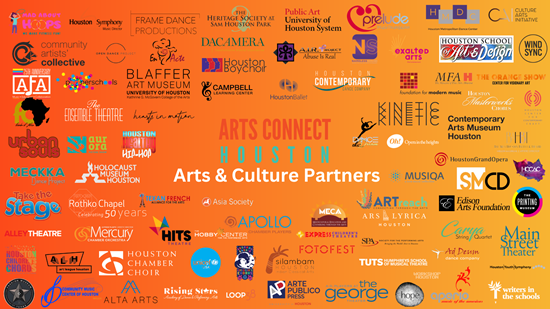
An orange to yellow ombre background with the title Arts Connect Houston Arts & Culture Partners in the center surrounded by 90+ Houston arts organization logos.

A collection of Houston arts organization logos that represent Arts Connect Houston's 90+ Arts and Culture partners.


If you'd like to be featured as one of our future Guild Spotlights, then be sure to fill out our interest form! If you have any questions on how to do so, please reach out to nataliavilela@nationalguild.org


Project STEP students and staff featured on the Kelly Clarkson Show

April 12, 2023

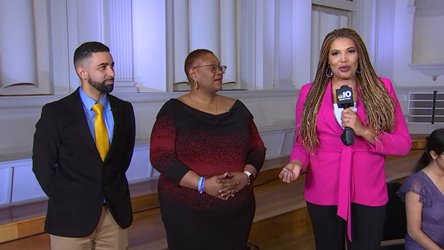
NBC 10 Boston anchor Latoyia Edwards and Project STEP program leaders Mariana and Josué standing next to each other - still from the Kelly Clarkson show.

On April 12th, Guild member Project STEP was featured on the Kelly Clarkson Show.

The show's Good Neighbor of the Year story features Dr. Ian Saunders, the Artistic Director of Project Step in Boston. NBC 10 Boston anchor Priscilla Casper shines a light on how Dr. Saunders and Project Step are transforming the face of classical music by providing underserved kids across Boston with free access to string instruments and lessons with professional orchestra musicians. NBC 10 Boston anchor Latoyia Edwards then joins live from Project Step’s recording studio with program leaders Mariana and Josué to present a special performance of “Sword Dance” by the students of Project Step. Watch the video clip here.

This incredible feature also received coverage in the Boston Globe.

Guild Spotlight: Nancy Kleaver of Dancing Classrooms


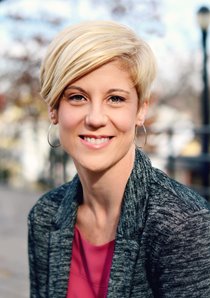
A headshot of Dancing Classrooms executive director Nancy Kleaver. She has short blonde hair and fair skin, and is wearing a pink blouse under a dark gray jacket.Introducing our first-ever Guild Spotlight! We’re excited for this opportunity to continue connecting and sharing with folks within the community arts education field. Throughout this year, we hope to further uplift the community participation, healing, and care that’s embedded within your amazing work, and to amplify its impact on communities nationwide.
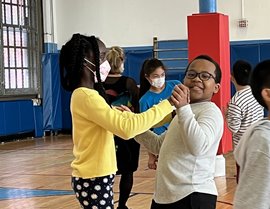
Recently we had the pleasure of connecting with Nancy Kleaver (she/her), executive director of Dancing Classrooms! As the largest dance education provider for New York City public schools, Dancing Classrooms also supports an affiliate network of sites around the country, cultivating engaged learners and collaborative leaders through the joyful art and practice of social dance.

Learn more about how her organization amplifies connection, joy, inclusivity, and more through dance on a local and national scale. 


Hi Nancy! Tell us about yourself and your organization.

My name is Nancy Kleaver and I'm the executive director of Dancing Classrooms. I've been the executive director here for about three years, and my entire career has been in community arts education. Coming out of college, I started working at a theater company in upstate New York and developing their school tours and residency programs.  I found my direction. I found my niche, my place. 

Dancing Classrooms loomed large in my understanding of the arts education landscape. The organization is going to be 30 years old next year, and it's probably best known for the documentary film Mad Hot Ballroom, though we've evolved in and do more than what is known from that program today. 

We're the largest dance education provider to New York City public schools. We serve over 15,000 kids just in New York City alone, and also support an affiliate network of ten sites around the country. It's an honor and a privilege to get to lead this company at this time in our history.

Our community is anyone who has always wanted to dance, but never felt brave enough to try.

Where are you located? Who is your community? 

Schools, particularly public schools, are our community. Students who never thought of themselves as dancers before are our community. We have been remote since 2016, 2017; they got rid of their office and studio space before I came on board. Even before the pandemic we were kind of everywhere and nowhere. We have school partners in all five boroughs and other districts in the metropolitan area. Most of the schools we work with have been partnering with us for more than 10 years—some over 20 years—so we have very close relationships with our school partners. We're really proud to see them through changes in leadership, and changes in neighborhood demographics.

Our community is anyone who has always wanted to dance, but never felt brave enough to try. We teach social dance and partner dance—dances that originated and are rooted in cultures and communities for community purposes. I like to think that—I do think, I know this is true because I see it happen—the dances we teach are more accessible than dance with a capital D, with a very serious choreographic vision. We teach dance to build connection and joy, and to create inclusive spaces. That's more important to us than the skills that students take away, and we do a lot of it.


How has community arts education supported in healing and/or meeting the needs of your community? 

We were really moved and touched around this time last year, because of culminating events. We do a showcase with the kids at each school at the end of a residency. It was the first time our school partners had opened up their building to families and their community, and we got to be an integral part of that homecoming. You could just see it in the room: parents there to cheer their kids on, and also super excited to see other parents and teachers and folks they haven't actually seen in person in two years. 

We kept dancing with the kids online, hybrid, socially-distanced. We did every variation you can imagine to keep them moving, and to keep them connected to music and culture and each other. What we heard again and again from the kids is, “I feel better.” “I have more energy.” “I didn't want to be here when we started the class, but by the end of the class, I'm really energized.” 

Dance is the most efficient and effective for student learning right now, because it does all three things: the mind-body-soul connection — it just hits all of those zones. Kids are creating these new neural pathways, and they're more ready to learn. They're more ready to deal with each other. They’re more able to reflect on how they're doing, how they're feeling, and I think we saw that across the board over the last three years. 


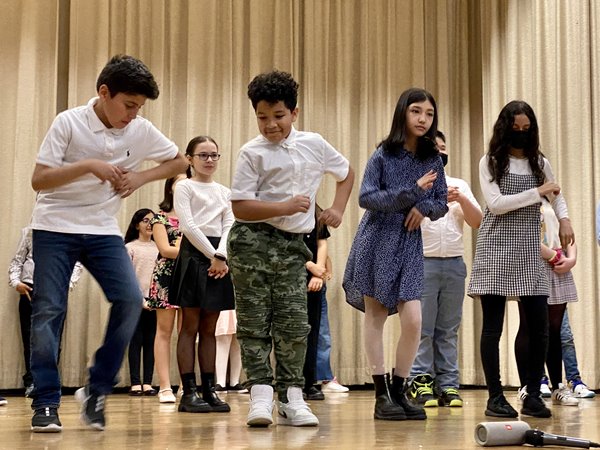
Students at their Culminating Event (PS 175Q) dancing the merengue (March 2022).

Students at their Culminating Event (PS 175Q) dancing the merengue (March 2022). Photo courtesy of Dancing Classrooms.


What are some challenges that your organization is currently facing?

I think there's two: one is kind of a social challenge, and another is financial. I think the social one, which is bigger than us but that I hope we're in a place to help with, is gender inclusion. During the three years that I've been at Dancing Classrooms, we've been going on a journey in truly making our programs gender-inclusive, which is a big deal in a genre that is known to be very normative. We needed to dispel the idea that what we teach is how to be a lady and a gentleman. That's too limiting, and it's not inclusive. So we're really busting those myths through our programs: We walk into a classroom and we just go *points* “1-2-1-2-1-2-1-2.” Everybody dances with everybody in this class. That's always been a part of our program.

Before the pandemic, it was more common that schools would automatically put them in lines — who they thought were boys and who they thought were girls, calling them ladies and calling them gentlemen. We're not doing it that way. When we come to a school, we're really about teaching teamwork and this art form, and understanding the cultural significance of the dances. The kids are growing into compassionate and collaborative human beings. 

With the kids it's working out beautifully, but it takes some uncomfortable conversations with the adults to get there sometimes. And we’re happy to have that, and just hope that through what we’re doing, we can introduce schools to the idea of gender inclusion in a way that’s less scary.

Financially, it’s like every arts organization, especially if you're working with schools, and your business model really relies on school budgets in New York City. I don't think we really know what's coming down the pike with the city budget next year, and the ebbs and flows of money that's available for the arts. This is a constant worry, a constant fear. 


What do you love about the work you do, and the community you work in?

I really love the footprint that our organization is able to have on New York City. Over the last couple of years, we've created a TikTok account, and you can just see it bubble up there: People will post a video of kids dancing, and all these kids from around the city going, “I did that dance!” “Miss Mary! I remember her! I was in that program!” Even just meeting people day-to-day: I tell them I'm from Dancing Classrooms, and they're like, “My kid had Dancing Classrooms at their school!” Teaching artists tell me they bumped into kids they taught on the playground in their neighborhood. Our impact really is there, even if they're not dancers themselves.


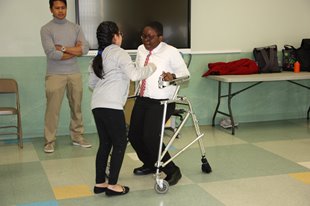
Student with a walking assistance device dancing with another student.   Couple in dance frame in their school gym (PS 1M) during their fall residency.

Left: Student with a walking assistance device dancing with another student. 
Right: Couple in dance frame in their school gym (PS 1M) during their fall residency.
Photos courtesy of Dancing Classrooms.


Do you have any highlights or stories regarding your work that you’d like to share? 

This year, we were able to relaunch an after-school program for kids who really got into partner and social dance, so they can take it to the next level. There’s a student named H* who found out about it somewhere online. H is on the spectrum. He's in middle school and has a hard time making friends. He saw the program and asked his parents about it, and they showed him some videos from Mad Hot Ballroom, and he wanted to do it! 

They took him to the first lesson and, immediately, it was the only thing he would talk about; every day he would ask whether there was another class, and if he could go back. His mom watched the lessons and couldn't believe that, by the third lesson, here was her son dancing with multiple people in the circle, making eye contact each time, and talking to them just spontaneously. She said she had never seen that before; he had never been able to just strike up a conversation. There was something in the space we created, and in the way we danced together that motivated him, and allowed him to feel safe enough to start making friends. There's nothing better than that.


Lastly, what does community arts education mean to you?

It’s art for the people! By the people! It's art that's not created to be sold or bought. It's inclusion. It’s a space of belonging. 


*Name removed for privacy.


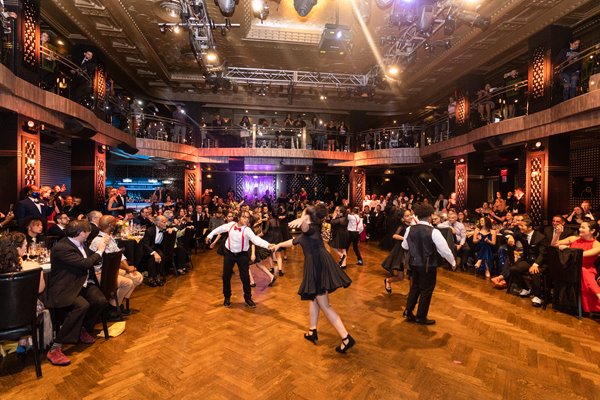
Student performance at Dancing Classrooms' annual fundraising gala MAD HOT BALL 2022 at Edison Ballroom (May 2022).

Student performance at Dancing Classrooms' annual fundraising gala MAD HOT BALL 2022 at Edison Ballroom (May 2022). Photo by Properpix Photos – Victor Nechay.


If you'd like to be featured as one of our future Guild Spotlights, then be sure to fill out our interest form! If you have any questions on how to do so, please reach out to nataliavilela@nationalguild.org


Mural Arts Philadelphia featured on Abbott Elementary

March 16, 2023

An advertisement for the series Abbott Elementary. The photograph is of seven individuals, six of them sitting inside an imaginary school bus and one standing in the middle aisle, wearing a patterned green and yellow dress. The logos for "Abbott Elementary", "ABC6", and "Hulu" are on the bottom-right corner. The logo for "Mural Arts" is on the top-left corner.

Shout out to Mural Arts Philadelphia, who were prominently featured in an episode of the Emmy and Golden Globe-winning ABC series Abbott Elementary! When the show's creator, Quinta Brunson, grew up in Philadelphia in the 2000s, Mural Arts Philadelphia came to her middle school to guide her class through creating a new mural. According to a tweet from Brunson, that childhood experience inspired the March 1 episode of the show, in which Mural Arts comes to the fictional Abbott Elementary to guide the students through designing and creating a mural.

Read more on the Mural Arts website.

The Hochstein School Appoints New President & Executive Director

April 26, 2022

The Hochstein School has announced the appointment of Hilary Field Respass as President & Executive Director as of July 1, 2022. Respass has served as Executive Director of Boston University Tanglewood Institute since 2014, and prior to that she held leadership roles at the community divisions of The Hartt School at the University of Hartford in Connecticut and New England Conservatory in Boston. Respass is a 2011 alumnus of the Guild's Community Arts Education Leadership Institute (CAELI).

Respass succeeds Peggy Quackenbush, who announced in September 2021 that this would be her last school year and she would be retiring as Hochstein’s President & Executive Director after more than 40 years at Hochstein. Quackenbush joined the Hochstein faculty in 1979 and has been Hochstein’s President & Executive Director since 1992. Ms. Quackenbush was a member of Guild board of trustees for many years, and was a 2012 recipient of the Guild’s Milestone Award.

Respass says, “As I journeyed through the search process these past few months, I have been moved again and again by the deep pride, caring, and commitment that The Hochstein School has for its teaching, its dance- and music-making, and for every person in its community. It is a privilege to succeed such a strong leader as Peggy Quackenbush, and I am honored and very excited to become part of this inspiring, extraordinary place.”

We want to congratulate Ms. Respass on her appointment, as well as Ms. Quackenbush on her retirement and many years of service!

Read more on The Hochstein School's website.

Flint School of Performing Arts’ Dort Honors String Quartet Documentary Wins National Awards

February 25, 2022
 
In January 2021, the Dort Honors String Quartet at the Flint School of Performing Arts, a Guild member, started working virtually with the Dover Quartet—one of the most in-demand ensembles in the world. The award-winning documentary, The Year of Haydn: COVID Can’t Stop the Music, highlights the marvelous musical match of quartets.
 
To date, The Year of Haydn: COVID Can’t Stop the Music has won a Best Short Documentary and
a Grand Jury Award for Best Cinematography at the New York International Film Awards. It was also nominated at the Idyllwild International Festival for Best Documentary Featurette, Best Director Featurette for Nicole Bowers Wallace and the Mary Austin Award for Excellence in Producing—a women filmmakers' award—for FSPA Director Davin Pierson Torre and Bowers Wallace. The Florence Film Awards gave it an honorable mention.
 
“This documentary means so much to so many people here at the Flint School of Performing Arts as well as to the Dover Quartet and its contemporaries,” explained Pierson Torre. “It gave an especially meaningful educational opportunity to our students during COVID when we were all online. To eventually be able to come together in person at the end and perform was an absolute joy!”
 
Watch the full documentary here.

Creative Spark Hosts Monthly Arts & Aging Gatherings

February 25, 2022

Creative Aging SF is holding monthly, virtual gatherings exploring themes relevant to the intersection of arts and aging. This collective celebrates shared spaces for learning, networking, and peer support. All are welcome to attend. If you would like to be a featured presenter or need more information, you can reach out to creativeagingsf@gmail.com.

The next gathering will take place on March 9th at 8pm ET / 5pm PT. The gathering will celebrate animal and human bonds, and  explore together the impact of this relationship on the health of individuals, care partnerships, and communities.

Gatherings are held on zoom. Details can be found on their facebook page here.