In a partnership, two plus two equals five. The ability to leverage another organization’s assets to accomplish something your organization could not do alone makes partnership powerful. But it also poses challenges, not least of which is the change it brings to both organizations. Engaging in a long-term partnership while staying true to your vision and mission requires some serious internal preparation and reflection to ensure that your organization is ready to partner.
Community arts education organizations create an atmosphere that promotes learning, individual growth, and fun. But they also have an obligation to keep their students safe from potential harm—including the harm of sexual abuse. Prevention encompasses some basic questions: What constitutes inappropriate or harmful behavior? What can we do to prevent it? How do we recognize it? How do we respond? What should we do about abuse at home, whether suspected or revealed by a student?
Around the globe, arts providers are struggling to fi gure out how to build an empirical argument for the importance of youth orchestras, theater programs in juvenile detention centers, or creative writing for seniors. And as the expectations around “hard” evidence become more explicit, many organizations turn to evaluation with the hope that a study of their programs will provide the “armor of evidence” they feel they need.
But a pause may be in order. Beyond the literal dollars, an evaluation costs staff time and organizational resources. There will be hours of preparation, data gathering, refl ection, and drawing the implications for future practice. So here are 10 conversations that any organization about to invest its human or fi scal capital in an evaluation ought to take on—before it plunges ahead:
Many organizations wonder if their faculty, staff, or exective directors should be on the organization's board. Michael Kumer shares his thoughts.
Creative Communities is a ground-breaking initiative to bring high-quality arts instruction to underserved children and youth in public housing communities. Developed in 2001 as a collaboration among the National Guild for Community Schools of the Arts, the U.S. Department of Housing and Urban Development (HUD), and the National Endowment for the Arts (NEA), the Initiative (CCI) was the first-ever collaboration between NEA and HUD and represented a $4.65 million investment in, and commitment to, community arts education.
Carlo Cuesta explores how to engage board members in fundraising for your organization – even if your board is not a fundraising board.
We spoke with Ron Chew about the five essentials and the qualities of leadership that can build public support for arts education and help sustain your organization.
Storytelling is a powerful marketing strategy because “stories appeal to the heartstrings more than a rational list of data points,” Yngve says. They make the mission and the need tangible by introducing real people like Isaias and his family. Donors are motivated to help the organization be successful, and the public is inspired to participate.
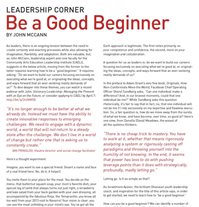 As leaders, there is an ongoing tension between the need to create certainty and exacting processes while also allowing for imagination, flexibility, and adaptation. Both are valuable, but, as John McCann, leadership expert and core faculty for the Community Arts Education Leadership Institute (CAELI), suggests in this GuildNotes article, moving from the former to the latter requires learning how to be a “good beginner.”
Nonprofit sustainability lies at the intersection of exceptional impact and financial viability. In this informative and practical webinar, nonprofit and leadership expert Jan Masaoka provides a framework that will help executives and boards at community arts education organizations integrate financial performance and mission considerations into their strategic decision-making.