Webgathering Resource Guide
As more gather online, the Guild has created an editable Google Sheet with basic resources for Zoom, Google Hangout, and Live Streaming.
This guide is editable and open to all.
As more gather online, the Guild has created an editable Google Sheet with basic resources for Zoom, Google Hangout, and Live Streaming.
This guide is editable and open to all.
In Seattle, classroom teachers and teaching artists are working collaboratively to provide students with creative, arts-based learning that is rooted in concepts of indigeneity, decolonization, and the use of liberatory frameworks. The Ethnic Studies and Theater of the Oppressed project, developed in partnership with the city-wide initiative Creative Advantage, brings teachers and teaching artists together to explore dynamics of power in order to co-create and engage in meaningful and relevant content with students.
In this one-hour webinar, we took a close look at this highly collaborative work and shared strategies for integrating similar creative youth development and social justice practices into your own professional development, teaching artist coaching and mentorship, and arts integrated curriculum.
Speakers:
James Miles, Executive Director, ArtsCorps
Jennifer Dunn, Teacher, Seattle Public Schools
Rachel Atkins, Playwright and Teaching Artist
Tina LaPadula, Teaching Artist / Arts & Equity Consultant, HeARTWork Collective
Resources mentioned:
Washington State Ethnic Studies Now
Games for Actors & Non-Actors by Augusto Boal
Theatre of the Oppressed by Augusto Boal
How to Be an Anti-Racist by Ibram X Kendi
Pedagogy of the Oppressed by Paulo Freire
Pedagogy for Liberation by Paulo Freire
Consider buying your books at a local black-owned bookstore
Social justice in the field of creative youth development (CYD) means working with youth from multiple identities to expand and nurture their analytic sensibilities, creativity, self-reflection, and critical thinking skills to engage them in the work of fighting for visibility, inclusion, and intersectional justice. It also means promoting and supporting youth culture as a mechanism to drive youths’ understanding of and ability to challenge racial violence, and structural and systemic oppression.
Join Dr. Bettina Love for a discussion of key insights and recommendations presented in her recently released paper, "Working in Social Justice," published by Americans for the Arts and the CYD National Partnership. Dr. Love will be joined by three nationally-recognized practitioners from Groundswell (Brooklyn, NY), Destiny Arts Center (Oakland, CA), and RE:FRAME Arts Center (Phoenix, AZ) who together will explore how frameworks in CYD that are grounded in social justice not only benefit youth, but all of us.
Presenters:
• Bettina Love, author and Associate Professor of Educational Theory & Practice at the University of Georgia.
• Ashley Hare, Co-Founder, RE:FRAME Youth Arts Center, Phoenix, AZ and National Coordinator, CYD National Partnership
• Robyne Walker Murphy, Executive Director, Groundswell, Brooklyn, NY
• Mika Lemoine, Mentor Teaching Artist, Destiny Arts Center, Oakland, CA
For the second webinar in the Creative Youth Development Learning Series, researcher Denise Montgomery of CultureThrive discussed the following five trends in CYD program development:
Denise was also joined by two field experts who will share their perspectives as practitioners and who will bring depth and dimension to this national conversation: Cristy Johnston Limón (Executive Director, Youth Speaks) and Shelby Williams-González (Executive Director, artworxLA)
This virtual learning series is brought to you by the Creative Youth Development National Partnership in collaboration with the Grantmakers for Education Arts Education Impact Group. One of the National Partners, Americans for the Arts, recently spearheaded the development of 7 written briefs authored by field experts as part of the first phase of a creative youth development toolkit for the field. All webinars are hosted by the National Guild for Community Arts Education and made possible by generous support from the Clare Rose Foundation.
Previous webinar: Working With Youth watch the webinar recording and read the landscape analysis paper.
So often we adults find ourselves in rooms making decisions on programming and policy we think are best for young people. We make these decisions without their voices, even though they are the ones who will be directly impacted by our choices. But as we are seeing nationally and globally, young people are speaking up to become their own agents of change.To truly give them the space they are demanding, we must rethink what it means to co-lead with young people.
In this webinar, members of the CYD National Action team share the findings of a recent research paper, and we hear from youth organizers about how adults should most meaningfully collaborate with young people in their work.
View the slides from the presentation
Read the full research paper by Ashley Hare
Learn more about the work of the national partnership.
For the first-time in U.S. history, older adults (65+) are projected to outnumber youth (18 and under) by 2035. Nonprofit arts education organizations are uniquely positioned to play a leading role in providing innovative programming for an aging population that is living longer, healthier lives. But according to a recent field survey, only 30% of the field currently provides older adult programming.
Learn how you can jump-start older adult programming at your organization in ways that promote creativity, equity, community, and joy. In this interactive webinar, you'll hear from representatives of four recent grantees of the National Guild's Catalyzing Creative Aging program, a partnership with Lifetime Arts. Each of these organizations has launched successful creative aging programming at their institutions and laid the groundwork to sustain and grow these programs over time. Join us to hear what's working, how they're solving common challenges, and what they've learned about program development, student recruitment, partnerships, and funding.
Presenters:
Also Available:
Designing for Engagement Report
Slides from Webinar Presentation
Supplemental Q&A after Webinar
Arts learning programs that intentionally integrate creative skill-building and expression with positive youth development principles fuel young people’s imaginations, strengthen their leadership, and build critical learning and life skills. A newly released Wallace Foundation report—Designing for Engagement: The Experiences of Tweens in the Boys & Girls Clubs Youth Arts Initiative—finds tween participants who participated in programs of this kind within general youth-serving organizations improved not only artistic skill, but also social-emotional learning, and had increased club attendance and retention. The study offers empirical evidence of the value of high-quality afterschool arts programs for low-income tweens and suggests lessons for both arts and non-arts youth serving organizations.
Watch this webinar to learn how to deepen your arts learning practice to attract youth and create measurable benefits. You'll gain insights and practical advice about effective practice and program implementation from the perspectives of a researcher, funder, program administrator, and teaching artist.
Presenters:
This webinar is ideally suited for arts organizations looking to more intentionally integrate youth development principles into their practice as well as general youth-serving organizations, such as Boys and Girls Clubs, aiming to establish or deepen high-quality arts learning programs at their organizations.
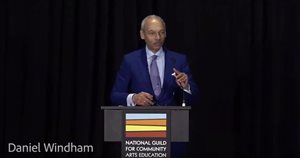
The 2018 National Guild Service Award recognizes Daniel Windham's remarkable service to the field as a dedicated Guild trustee and officer, as well as through his many contributions in leadership positions at the Wallace Foundation, Cleveland Music School Settlement, Kansas City Young Audiences, New York Philharmonic, and the National Symphony Orchestra. His commitment and leadership have had significant impact on the entire the field of arts education in the United States and contributed greatly to forwarding the Guild’s mission of ensuring all people have opportunities to maximize their creative potential.
Following his plenary speech, The Art of Leadership (An Ode to Ella), Carlton Turner sat down with Cristy Johnston Limon, executive director at Youth Speaks, for a discussion on what arts leaders can learn from movement organizers, how to learn from failure, and what radical leadership looks like in 2019.
Hear from several key Baltimore figures who are shaping arts and activism in the city. Leslie King-Hammond, Kibibi Ajanku, Brayaira Simms, and Loring Cornish answer questions from attendees around their struggles and perseverance artists, the inspirations they draw from Baltimore, and how they navigate the daily realities of structural racism.