Shawn Ginwright on the Future of Healing

In a new essay, Shawn Ginwright, professor at San Francisco State University and keynote speaker at the Guild’s 2015 Conference, argues that youth development models should move from “trauma informed care” to “healing centered engagement.” While acknowledging the importance of trauma-informed work, Dr. Ginwright’s own experience working with young people—in particular, young African American men who have experienced severe trauma—indicated that the term “trauma-informed” did not “encompass the totality of the [young people’s] experience[s] and focused only on [their] harm, injury and trauma.”

“For me, I realized the term slipped into the murky water of deficit based, rather than asset driven strategies to support young people who have been harmed. Without careful consideration of the terms we use, we can create blind spots in our efforts to support young people,” writes Dr. Ginwright.

After identifying possible deficiencies with the “trauma-informed” framework—including that it focuses on individual rather than collective harm, and that it is centered on pathology rather than possibility—Dr. Ginwright offers a “healing centered” lens as an alternative approach. According to the essay:

“A healing centered approach is holistic involving culture, spirituality, civic action and collective healing. A healing centered approach views trauma not simply as an individual isolated experience, but rather highlights the ways in which trauma and healing are experienced collectively. The term healing centered engagement expands how we think about responses to trauma and offers more holistic approach to fostering well-being.”

You can read the full essay here.
New Research: Benefits of Arts Integration Programs, Possibilities for Funding

Community arts educators advocate strongly for the importance of arts integration in K-12 schools. However, it’s not always clear how much data—particularly robust quantitative data—there is to back up the case. New research from the American Institutes for Research (AIR) is helpful for starting to fill that gap. According to the Wallace Foundation, the research “finds that high-quality programs that incorporate music, theater or other arts into core subjects such as English and math can make a difference in learning.” Furthermore, the study details how specific arts integration programs may be eligible for funding under the Every Student Succeeds Act (ESSA).

“AIR researchers scoured studies of arts-integration programs and found 44—a substantial number—that meet the standards of evidence the law requires. Programs that fit the bill incorporate a range of activities, including teacher professional development, school improvement efforts, procurement of instructional materials and supports for English learners,” writes the Wallace Foundation.

You can see the presentation given by AIR on the report or read the full document here.

Introducing the 2018 Class of CAELI

The National Guild for Community Arts Education is pleased to announce the 2018 class of the Community Arts Education Leadership Institute (CAELI). Twenty-six individuals representing community arts education organizations across the nation were selected to participate in CAELI, a leadership program designed for individuals in the nonprofit arts education sector.

Over the course of eight months, the program provides participants the opportunity to hone and advance leadership skills and effectiveness through a sequential curriculum that includes virtual workshops, one-on-one coaching with top trainers and practitioners, and an introspective dive into how being a leader impacts the personal and the professional. Participants attend a five-day, in-person seminar held at Bryn Mawr College in Philadelphia, PA in July.

The CAELI class of 2018 will join an alumni network, more than 200 members strong, offering peer mentorship and a trove of resources for continued development long after the conclusion of the program. Together, these leaders represent our best opportunity to ensure all people have access to opportunities to maximize their creative potential.

“We are excited to welcome the class of 2018,” said National Guild executive director Jonathan Herman. “Organizations need strong leadership to secure their futures and to ensure equitable access to lifelong learning in the arts for all. We look forward to seeing how this talented group of leaders shape the future of arts education.”

CAELI is now in its ninth year and is led in collaboration with Partners in Performance, Inc.

Supporters of CAELI have included American Express Foundation, The Cleveland Foundation, Pennsylvania Council on the Arts, the National Endowment for the Arts, the National Guild's board of trustees, and other generous individuals.

Through a competitive process, this year’s class includes:

  • Jeffrey Allen, Director of Arts Education, Cleveland Metropolitan School District, Cleveland, OH
  • Nicole Amri, Program Director, SAY Sí, San Antonio, TX
  • Mariana Astorga-Almanza, Visual and Performing Arts Coordinator, Lynwood Unified School District, Lynwood, CA
  • Ashley Blakeney, Program Manager, Pablove Foundation, Los Angeles, CA
  • Lindsey Buller Maliekel, Director of Education/Public Engagement, The New Victory Theater, New York, NY
  • David R. Carter, Executive Musician, Tulsa Symphony, Tulsa, OK
  • Eepi Chaad, Youth and Community Outreach Coordinator, Art League Houston, Houston, TX
  • Jennifer DiFiglia, Senior Director of Programs, LEAP, New York, NY
  • Tarah Ortiz Durnbaugh, Performance Programs Manager, Urban Gateways, Chicago, IL
  • Paul A. Ellis, Jr., Executive Director and General Counsel, August Wilson House,
  • Pittsburgh, PA
  • Quanice G. Floyd, Founder and Director, Arts Administrators of Color Network, Washington, DC
  • Julianne Gadoury, Arts Education Coordinator, New Hampshire State Council of the Arts, Concord, NH
  • Lynn Hoare, Senior Director of School-based Programs, Creative Action, Austin, TX
  • Rosa Hyde, Senior Manager, New Jersey Performing Arts Center, Newark, NJ
  • Jackson Elisabeth Knowles, Program Director, MINDPOP, Austin, TX
  • Kearsten Kuroishi, Director of Education, City of Las Vegas’ Rainbow Company Youth Theater, Las Vegas, NV
  • Julia López, Programs Manager, Mural Arts Philadelphia, Philadelphia, PA
  • Emily Magenheimer, Campus Manager, Levine Music, Washington, DC
  • Kevin D. Marr II, Dance Director, All-City Dance Ensemble, Cleveland, OH
  • Devon Miller, Managing Director, Junior Players, Dallas, TX
  • Beverly E. Mislang, Associate Director of Development, Youth Speaks, San Francisco, CA
  • Paul Moshammer, Studio Director, Creativity Explored, San Francisco, CA
  • Rebekka Nickman, Program Manager, DC Collaborative, Washington, DC
  • Melissa Gawlowski Pratt, Assistant Director, Lincoln Center Education, New York, NY
  • Chad Swan-Badgero, Program Manager, Michigan Council for Arts and Cultural Affairs,
  • Lansing, MI
  • Molly Terbovich-Ridenhour, President and Chief Executive Officer, San Diego Civic Youth Ballet, San Diego, CA

Lifetime Arts, AAM Announce Seeding Vitality Arts in Museums

Aroha Philanthropies, Lifetime Arts, and the American Alliance of Museums announced on May 29 that they will collaborate to launch Seeding Vitality Arts in Museums. The project will enable a diverse cohort of 15-17 museums across America to develop and implement high quality, intensive arts learning opportunities for older adults. All types of museums will be eligible to apply, including art museums, science centers, history museums, arboretums, and zoos. Aroha Philanthropies will provide program funding to selected museums for up to two years as well as access to the training and technical assistance needed for them to be successful.

Seeding Vitality Arts in Museums will build on the success of Aroha’s two previous cohorts, Seeding Vitality Arts U.S. and Seeding Vitality Arts MN.

The goals of Seeding Vitality Arts are to:

  • Demonstrate the power and impact of creative aging programs to a broad national audience
  • Encourage arts and cultural organizations to develop participatory arts education programs for older adults
  • Encourage organizations that serve older adults to develop arts education programming
  • Disseminate effective program models

The National Guild, in partnership with Lifetime Arts, is also working to bolster creative aging in community arts education. You can learn more about the Catalyzing Creative Aging program here.

Read more about the Aroha, Lifetime Arts, AAM partnership here.

Lifetime Arts, AAM Announce Seeding Vitality Arts in Museums

Aroha Philanthropies, Lifetime Arts, and the American Alliance of Museums announced on May 29 that they will collaborate to launch Seeding Vitality Arts in Museums. The project will enable a diverse cohort of 15-17 museums across America to develop and implement high quality, intensive arts learning opportunities for older adults. All types of museums will be eligible to apply, including art museums, science centers, history museums, arboretums, and zoos. Aroha Philanthropies will provide program funding to selected museums for up to two years as well as access to the training and technical assistance needed for them to be successful.

Seeding Vitality Arts in Museums will build on the success of Aroha’s two previous cohorts, Seeding Vitality Arts U.S. and Seeding Vitality Arts MN.

The goals of Seeding Vitality Arts are to:

  • Demonstrate the power and impact of creative aging programs to a broad national audience
  • Encourage arts and cultural organizations to develop participatory arts education programs for older adults
  • Encourage organizations that serve older adults to develop arts education programming
  • Disseminate effective program models

The National Guild, in partnership with Lifetime Arts, is also working to bolster creative aging in community arts education. You can learn more about the Catalyzing Creative Aging program here.

Read more about the Aroha, Lifetime Arts, AAM partnership here.

Art Gives a Lifeline to Veterans Coping with Trauma

recent article in the Los Angeles Times highlighted the growing relationship between trauma, art, and healing, particularly in the context of military veterans. For one veteran, Sgt. Mike Dowling, creative writing was a profound vehicle healing. "Writing that book was a cathartic experience," said Dowling, speaking to the LA times. "Once I got it down on paper, it felt OK to talk about what had been deeply repressed, painful feelings. I found that through writing, I could actually channel some of the energy of certain memories and images into artistic reflections that were empowering."

According to the article, “Art therapy has long been a component of school counseling departments, acute care hospitals and nursing homes. But now it's also being tapped by veterans' agencies and clinics for its value as a constructive expression of states of mind both extreme and inescapable.”

For those dealing with post-traumatic stress disorder, art is often one of the only ways to explore deep feelings of pain in a way that is expressive and liberating. For one expert, Tess Banko, executive director of the UCLA Veteran Family Wellness Center and a Marine Corps veteran, the key is the role that art plays in promoting love. "It is important to know that someone loves you — even it is only you — and that is where artistic expression can really make a difference."

Read the full article here.

New Book: Make Time for Making Music

A new book from Amy Nathan, Making Time for Making Music: How to Bring Music into Your Busy Life, explores how time-stretched adults can make focused time to follow their musical passion. The book draws on conversations with an “advice panel” that includes numerous Guild members, including: Eastman New Horizons Chorus, Harmony Project, Peabody Preparatory, San Francisco Community Music Center, and Third Street Music School.

According to Erika Floreska, executive director at Bloomingdale School of Music, “Amy Nathan once again opens up the world of music to make it more accessible to more people. This book, by focusing on real stories, challenges, and benefits adults have faced keeping and bringing music into their lives, demonstrates how music is for all—at any level, at any point in life. Makes me want to get my flute out!”

The book demonstrates the wide-ranging avenues for accessing music and music education, while also exploring the long-term benefits on health and well-being. According to the author, “the book is filled with real-life success stories from more than 350 adults in the U.S., UK and elsewhere (ranging in age from 25 to 96) who don’t have musical careers but still fit in time for music-making."

Making Time for Making Music is a reminder that there is always enough time for the things that matter.

You can learn more about the book here.

Erika Floreska Describes Her Journey as an Arts Leader

In a recent interview for Bird, Erika Floreska, executive director at Bloomingdale School of Music (New York, NY), shared her experience in the arts, as well as the leadership journey that brought her to an executive director position. In particular, she discussed what it takes for her to remain successful in her role, and how others might approach their own career development.

On the difference between being a director and an executive director:

Fundraising! [Laughs] An executive director is responsible for the whole institution. So you're managing budgets, getting money into the school, and getting people engaged. Executive directors are more focused on relationships. You have to tell the story of your institution, sell people on it and get them invested, and then ask for support. A director looks inward by focusing on faculty, teaching, and what’s happening in the school. An executive director looks outward.

On joining Bloomingdale at a time of transition:

It’s been an interesting journey. When I first arrived three years ago, the school was in a hard place. They’d just lost their executive director of 25 years, and they were operating in a very stunted way. It had been the same for many years. Everything had to change to keep up with the times. Enrollments were down, the systems were tired, and the school had been running financial deficits for five years.
It was overwhelming to walk into. But the faculty and the student inspired me to take on the challenge.  The school has such a strong financial aid and scholarship program, and it’s really ingrained in the history of this community. The core of Bloomingdale was so strong, I knew that I could get it back on track and really help the school grow.

On advice for other leaders:

Understand where you get your energy. What brings you joy? Build a career around that. For me, to see a kid learn how to persevere when things go bad is incredible. We had this adorable five-year-old who had won the at the previous year’s performance. He was playing the following year and, all of a sudden, he stopped and couldn’t remember his next line of music. Eventually he figured it out and kept playing, but he was distraught afterwards. His teacher was there, and explained that it happens to everybody, and that the important thing was that he finished the piece. Learn from this and move on. It’s a privilege to see that.

You can read the full interview here.

Bloomberg Expands Arts Innovation and Management Program

Bloomberg Philanthropies is investing $43 million in over 200 small and midsize arts organizations in seven cities, according to The New York Times. The supported cities include Atlanta, Austin, Baltimore, Denver, New Orleans, Pittsburgh, and Washington.

“By invitation only, selected organizations are being offered unrestricted support — roughly 10 percent of their annual operating budgets — in addition to arts-management training. That includes a consulting mentor for each organization and a series of seminars for all grantees in a given city on topics such as fund-raising, strategic planning, marketing and board development.”

The funding is provided through a cohort model. Grant recipients in particular cities connect with one another during the training process. According to the NY Times, “Each institution is asked to match 20 percent of the dollar amount it is given — a chance to put into practice some of the fund-raising tools offered through the program.”

Read the full article here.

National Guild Joins Host Commitee to Welcome DOE Chancellor

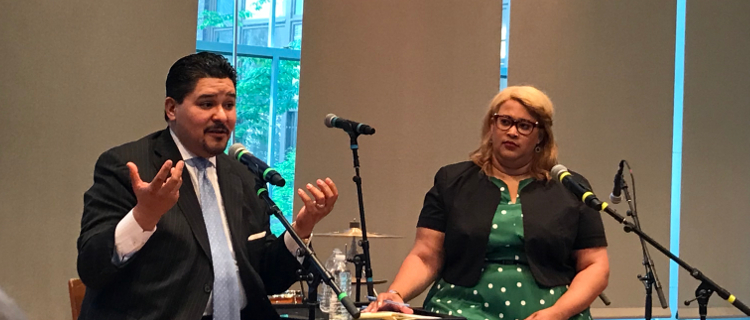
On Wednesday May 9, 2018, New York City arts educators welcomed Richard A. Carranza, the new Department of Education Chancellor. The National Guild participated as a member of the host committee, alongside Americans for the Arts, Arts Education Partnership, Carnegie Hall, Center for Arts Education, Cultural Institutions Group, and New York City Arts in Education Roundtable.

The welcome featured performances from Guild members DreamYard (Bronx, NY) and Carnegie Hall’s Future Music Project (New York, NY). Courtney Boddie, director of education and school engagement at The New Victory Theater (New York, NY), moderated the conversation with Mr. Carranza. During the presentation, Mr. Carranza also performed for the group, demonstrating his talents as a mariachi musician.

Mr. Carranza is tasked with educating over 1.1 million students and, in regards to arts education, faces an uphill battle. According to 2014 data from the city comptroller, 28 percent of NYC schools have no certified arts teachers, 16 percent of schools have no arts or cultural partnerships, and 10 percent of schools have no dedicated arts room. A recent article in the NY Times highlighted that, as large, struggling public school are shuttered by the DOE, the smaller schools that take their place are not providing comprehensive arts learning, particularly music education.

The Chancellor has noted that he hopes one of his legacies will be that “New Yorkers have really seen how students have much more diversity in what their experiences are in fine arts.” During the welcome, he expressed a similar commitment to supporting arts education and using it as a tool to drive student success.

You can read Mr. Carranza’s full interview with the NY Times here.