Lisa Fiorentino Named Chief Executive Officer of Indian Hill Music

Indian Hill Music (Littleton, Massachusetts), a non-profit center for music education and performance, has named Lisa Fiorentino as its chief executive officer. Fiorentino has been at Indian Hill Music for 10 years, most recently as the organization's chief operating officer. She is stepping into the chief executive officer role as Susan Randazzo, co-founder and current executive director, is transitioning into a role focusing on long-term institutional advancement. 

Indian Hill Music is currently in the process of creating a world-class education and performance center on 110 aces in Groton, Massachusetts, which will be home to a 1,000 seat concert hall, a 300 seat recital hall, rehearsal and recital spaces, and a lawn for summer concerts. Slated to open in 2022, the Music Center will be a regional gathering place for music education and performances in Central Massachusetts and beyond. 

We have an extraordinary opportunity to create one of the most ambitious cultural projects in New England," Fiorentino says, "a world-class music center for teaching, performance, and community partnership. Our organization provides exceptional and vibrant music experiences that educate, energize, and enrich our community. I look forward to working with Indian Hill’s outstanding team of staff, faculty, musicians, and board members to deepen our impact in the region.”

Read the full release and learn more about Indian Hill Music.
Philadelphia Music Educators Attend Professional Development Day Hosted by Members

The Philadelphia Music Alliance for Youth—which consists of nine partner organizations including Guild members Settlement Music School, Play On, Philly!, and Temple Univiersity Music Preparatory Division—and the School District of Philadelphia's Office of the Arts & Academic Enrichment collaborated to host the first ever shared professional development day on January 18. The free event drew 252 music education teachers from local cultural organizations as well as district music educators in an effort to align, enrich, and expand music education opportunities for students across the city. 

Attendees heard from Nicole Robinson, creator of Cultural Connections by Design, a music educator with a special interest in working with urban school districts. Breakout sessions focused on topics ranging from building relationships with students, the importances of emotional health and career longevity, and coding in the music classroom. 

Read more about the event here.

Old Town School of Folk Music’s Executive Director Resigns

The Old Town School of Folk Music (Chicago, IL) has announced that executive director James "Bau" Graves is stepping down to retire. Graves is currently on medical leave following a hospitalization in November due to blockages in three coronary arteries, according to a release from the school. 

“It has been my honor and great privilege to serve Old Town School and its extended community for 11 years,” Graves wrote in a letter to the school’s staff. Rashida Phillips, the school's deputy director, will act as interim director. 

The school has recently been at the center of controversy over the proposed sale of one of its locations. Students and teachers rallied to save the building, and the school announced it will not list it for sale until March 31 in order to continue discussions with the community. 

Read the full story here.

Looking Toward a Nation at Hope: New Report from the Commission on Social, Emotional, and Academic Development

ThNational Commission on Social, Emotional, and Academic Development released the results of a two-year long study, funded in part by the Wallace Foundation, examining the importance of social and emotional learning. The report makes key recommendations for improving education outcomes, rooted in the key finding that “social, emotional, cognitive, linguistic and academic development are deeply intertwined in the brain and in behavior."

Researchers recommend that schools utilize community-based partnerships, including arts, music, youth development, and mental health services, to improve outcomes for students.

Read more about the study and access the full report.

Carnegie Hall’s Play USA Eligibility Forms Open February 1

Carnegie Hall's Play USA program supports partner organizations across the country with funding, training, and professional development for teachers and arts administrators working to offer instrumental music education to low-income and under served K-12 students. 

Application forms open February 1, and are due March 15. Partners will be announced June 28. Read more here. 

Mellon Foundation Grants $2.2 Million to Advance Poetry

The Andrew W. Mellon Foundation has awarded $2.2 million to the American Academy of Poets. Funding will be divided into two grants, one of which will start a new fellowship supporting poet laureates of US states, cities, territories, or tribal nations. The second grant will go to the Poetry Coalition, a national alliance of more than 20 poetry organizations, to support the coalition's work and to fund part-time paid positions at select member organizations. 

Elizabeth Alexander, the president of the Mellon Foundation and a poet herself, said it was the largest donation the foundation has ever awarded for poetry. 

Read the full article here.


RAW Art Works Student Awarded Full College Scholarship

RAW Art Works (Lynn, MA) Reel to Reel Film School student Michaela Olabisi has been awarded the Questbridge National College Match Scholarship to attend Vassar College in the fall. The scholarship, which covers her full tuition, helps low-income, first generation students get into and attend prestigious schools. 

Michaela has been involved with RAW since eighth grade, and says she does not think she would be where she is today without the after-school arts organization. Through their Reel to Reel Film School, they engage students in the art of visual storytelling through the process of making a film. Michaela's film, "The Missing Element," is a film highlighting the lack of acknowledgment towards people of color in the STEM field.

Read the full story here. Learn more about Reel to Reel Film school here, and watch Michaela's video here.

New Report from the Commission on Social, Emotional, and Academic Development

A new report from the National Commission on Social, Emotional, and Academic Development, funded in part by the Wallace Foundation, explores social, emotional, and academic development in young people. Recognizing that academic learning and social and emotional learning are intertwined, the report makes key reccommendations about creating visions for student success, changing institutions to teach students social, emotional, and cognitive skills, and aligning resources across partnerships with schools, families, and communities.

Researchers also reccommend bringing assets of community organizations, including arts and music, into schools to support the development of the whole child.

You can read more about the report here, and download the full report here.

Groundbreaking SFCMC Study Explores Impact of Community Choir on Older Adults

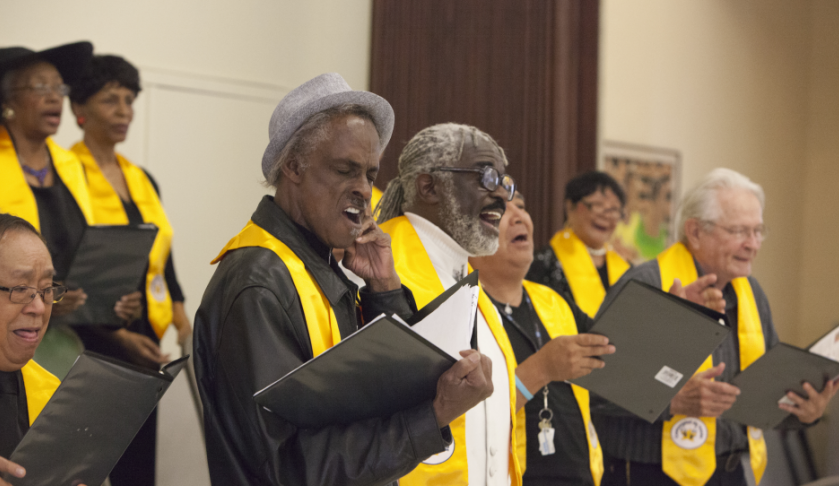
The San Francisco Community Music Center (SFCMC), in collaboration with UC San Francisco and the San Francisco Department of Aging and Adult Services, has completed the Community of Voices Trial. The study, funded by a five-year grant to UCSF from the National Institute on Aging of the National Institutes of Health, aimed to examine whether singing in a community choir is a cost-effective way to promote health and well-being among culturally diverse older adults. The results have now been released in the Journal of Gerontology: Psychological Sciences, as well as being shared publicly on the Community of Voices Website.

“We hear from our older adult choir members all the time how singing in the choirs lifts their spirits, but it’s wonderful to get this confirmation from a research study about the impact of singing in a choir for older adults. We are grateful to UCSF and Julene Johnson for their work on this,” comments Julie Rulyak Steinberg, executive director, Community Music Center.

The study followed twelve community choir groups made up of 390 socioeconomically and racial/ethnically diverse adults aged 60 and over. Led by professional choir directors and accompanists, choirs practiced and performed music that was culturally specific to each community and appropriate for older adults with varied singing and music-reading abilities. Researchers examined the physical, cognitive, and psychosocial impacts on choir members by measuring health and wellbeing outcomes including memory, cognition, feelings of loneliness, and interest in life.

Researchers found significant improvements in loneliness and an interest in life for older adults who sang in a choir for six months. There were no substantial differences in cognitive ability, physical outcomes, or health care costs. “We were a little surprised not to see improvements in cognitive and physical function, especially because the literature, although small, suggested there should be improvements,” said lead author Julene Johnson, PhD, associate dean for research and professor in the UCSF School of Nursing. “However, our study is one of the first randomized controlled trials of a choir intervention, whereas the others were cross-sectional or did not randomly assign the participants.” More research is needed on how choirs improve well-being and the potential long-term health impacts, said Johnson.

With an aging population and a lack of social systems to adequately support them, the risk for social isolation, depression, and loneliness is older adults is high. Community choirs represent one creative and accessible approach to engage older adults in the arts because they are low cost to deliver, engaging, and can be culturally tailored to each community.

You can read the full press release here, and access the Community of Voices Study Choir Program Manual here for a guide to creating a community choir for older adults.

Luis Garden Acosta, Founder of El Puente, Passes Away

Luis Garden Acosta, founder of the influential Williamsburg-based community organization El Puente, passed away on January 9. According to an account from local historian Geoff Cobb, "Acosta was the founder and president of El Puente, a nationally celebrated, Brooklyn based, community/youth development organization. A man of great passion, Acosta was so active in a variety of fields that he defied easy identification. The community organizer and advocate for the disadvantaged was also an environmental leader, a housing activist, and an educator, but he was something even bigger than these various roles. Acosta embodied the fighting spirit of the Hispanic community in North Brooklyn and his death leaves a massive void."

El Puente has played a significant role in shaping South Williamsburg and creating a model for community-based youth development organizations. The organizationa is "grounded in a holistic approach to leadership development for young people and their families, [bridging] the worlds of health, education, and the arts with activism and community empowerment."

Read more about the legacy of Luis Garden Acosta here.